Showing posts sorted by relevance for query dothan. Sort by date Show all posts

Tuesday, April 21, 2020

Dothan Alabama Malunjins


DOTHAN ALABAMA


THE FOUNDING OF DOTHAN


Marker Text: In the late 1700s and 1800s, horse and ox-drawn covered wagons from Charleston, Savannah, and Jacksonville traveled across the South as pioneer families searched for a place to build new homes and to start a new life. Those pioneers, who passed through the vast pine forests in the southeast corner of the territory that was later to become the state of Alabama, would often stop at a spring know as Poplar Head. Poplar Spring, named for the poplar trees that encircled the glade where the cool water, or ”head” (as springs were often called) welled from the earth. It was where ancient Indian trails met, crossed, and then continued on. The glade where the spring was located was often used by Indians from the various tribes of the Creek Confederacy as a meeting place and as a campground. By 1885, the hamlet had grown into a village. The new settlers realized that if the community’s growth was to be sustained, they would need a governing body and local law enforcement. On November 10, 1885, the people of Poplar Head voted to incorporate and took Dothan as the new town’s name since there was already was a Poplar Head, Alabama. The name come from Genesis 37:17 “….for I heard them say, Let us go to Dothan.” “A writer can put on paper the history of the town, but the history belongs to those who not only lived through the years documented, but who formed and molded out town into the city we know as Dothan.” – “Dothan, A Pictorial History,” 1984, by Wendell H. Stepp and daughter Pamela Ann Steep.

Before white men came, the Alibamu tribe lived along the Chattahoochee River, which forms the present boundary between Alabama and Georgia; on the banks of the Chocawhatchee, 35 miles west to where the villages of the Creek Confederacy.  These tribes were usually friendly, and they visited and traded with each other until well-beaten trails crossed at two large springs in a thick poplar grove about halfway between the two rivers. The Indians used this site as a camping ground.

In the early 1830's lumber and turpentine operators began crossing the Chattahoochee River into Alabama. They also found the clearing convenient and camped there on their way to Tombigbee settlements farther west. 


THE EMASSEEES AND MALUNJINS
One tribe of Indians and a community of mixed breed Indians were unmolested by the whites. These were the Uchees or Emassees, kinsman of the Seminoles or Creeks, who lived at the mouth of the Emassee or O'Mussee or Mercer creek near Columbia, and the Malunjins, a mixed breed community residing some three to sixmiles northeast of Dothan toward Webb even as late as 1865. Where the Malunjins came from nobody knows; where they were dispersed to is the limbo of forgotten men. B. P. Poyner, Sr., father of Houston County Probate Judge, S.P.Poyner, was born in the Malunjins' community. Some of these mixed breed Indians brought milkto Mr. Poyner's mother while he was an infant. The Emassees were allied by affinity with the Creeks and Seminoles yet during all of Alabama's territorial and state days were friendly to the whites. Only a squatter white family settled here and there and lived in old Henry County prior to 1817. Save for these squatters there were no white settlers in Henry County at the time of the Creek War of 1812-13.
The Alabama Lawyer: Official Organ State Bar of Alabama
By Alabama State Bar
Published by The Bar, 1942
Dothan Eagle (Dothan, Alabama)
27 Oct 1953

Mystery Of Malunjin Indians Baffles All Making Efforts Toward Solution


The Malunjin Indians - they walked the earth as late as 1865 - were quite a problem for those who have been helping put together the Houston County story.


Where they came from and where they went, nobody seems to know. The Malungjins carried their knowledge to the grave where most of it is preserved.

Oscar L. Tompkins, author of Wiregrass Sagas, gives the reader a fleeting glimpse of this tribe - but no more.

He points out that the Malunjins were a "mixed breed community, residing some three to six miles northeast of Dothan."

"Where they dispersed to is the limbo of forgotten men," Tompkins declares.
Tompkins got his trace of the Indians from the late B. P. Potner, born near the Malunjins' community.  Some of them used to bring milk to Mr. Poyner's mopther while he was quite young.  He could remember them.

The Poyners lived in the rural area of Houston County between Webb and Kinsey.
B.P. Poyner, Jr., Dothan businessman could shed little light on the Malunjuns- although baffling - were more truth than fiction, Eagle chroniclers fanned out their search.
It even led to the alabama Bureau of Archives and History. But the letter from there was as blank as the stares most people gave when you asked the stock question:
"Did you ever hear of the Malunjin Indians who used to live in Houston County?"

An Eagle reporter even interviewed a 104-year old man who spent most of his adult life in Kinsey.  His memory failed him on the Malunjin subject and the search continued.

Did you ever eat any Malunjin bread? Or did you call it "syrup cake?"

The Malunjins were noted for this mixture of flour, egg, milk, seasoning and syrup-instead of sugar.  This suggests that they made a meager existence.  Syrup being more plentiful than sugar and less expensive, was an ingredient that found its way into muc of the Malunjin squaw's cooking.

Exactly whether the Malunjins gave the Wiregrass cook this syrup cake delicacy can't be substantiated by records. But many believe they were the first to make syrup cake.   
And Malunjin bread still graces many a table, not always because the family can't afford sugar but because a good slice of syrup cake has no substitue.

When the white man moved into this territory to settle-the Indians notwithstanding-he left only two tribes unmolested, according to Tompkins' Sagas.

One was the Uchees or Emasees, kinsmen of the Creeks or Seminoles who lived at the mouth of the Emmassee (O'Mussee or Mercer) Creek near Columbia.

Part Indian

The other was the Malunjins of the 1860s. 

The Emassees were friendly to the whites throughout Alabama's territorial days which might explain why whites spared them.

The Malunjins were part Indian and part white which apparently explains why the whites spared them.

But where they came from-where they went, nobody seems to know.
Did you ever hear of the Malunjin Indians who used to live in Houston County?"

----------------------------------

More later on these Malunjin families, mixed Indians, found in Dothan, Henry County in the 1830s, the GIBSONS BUNCH CUMBO LOWERY etc.  Stay Tuned


Tuesday, June 2, 2020

Dothan


Malunjin Indians living in Albama, early 1800s


Dothan Eagle (Dothan, Alabama)
27 Oct 1953

Mystery Of Malunjin Indians Baffles All Making Efforts Toward Solution


The Malunjin Indians - they walked the earth as late as 1865 - were quite a problem for those who have been helping put together the Houston County story.


Where they came from and where they went, nobody seems to know. The Malungjins carried their knowledge to the grave where most of it is preserved.

Oscar L. Tompkins, author of Wiregrass Sagas, gives the reader a fleeting glimpse of this tribe - but no more.

He points out that the Malunjins were a "mixed breed community, residing some three to six miles northeast of Dothan."

"Where they dispersed to is the limbo of forgotten men," Tompkins declares.
Tompkins got his trace of the Indians from the late B. P. Poyner, born near the Malunjins' community.  Some of them used to bring milk to Mr. Poyner's mother while he was quite young.  He could remember them.

The Poyners lived in the rural area of Houston County between Webb and Kinsey.
B.P. Poyner, Jr., Dothan businessman could shed little light on the Malunjuns- although baffling - were more truth than fiction, Eagle chroniclers fanned out their search.
It even led to the Alabama Bureau of Archives and History. But the letter from there was as blank as the stares most people gave when you asked the stock question:
"Did you ever hear of the Malunjin Indians who used to live in Houston County?"

An Eagle reporter even interviewed a 104-year old man who spent most of his adult life in Kinsey.  His memory failed him on the Malunjin subject and the search continued.

Did you ever eat any Malunjin bread? Or did you call it "syrup cake?"

The Malunjins were noted for this mixture of flour, egg, milk, seasoning and syrup-instead of sugar.  This suggests that they made a meager existence.  Syrup being more plentiful than sugar and less expensive, was an ingredient that found its way into much of the Malunjin squaw's cooking.

Exactly whether the Malunjins gave the Wiregrass cook this syrup cake delicacy can't be substantiated by records. But many believe they were the first to make syrup cake.   
And Malunjin bread still graces many a table, not always because the family can't afford sugar but because a good slice of syrup cake has no substitute.

When the white man moved into this territory to settle-the Indians notwithstanding-he left only two tribes unmolested, according to Tompkins' Sagas.

One was the Uchees or Emasees, kinsmen of the Creeks or Seminoles who lived at the mouth of the Emmassee (O'Mussee or Mercer) Creek near Columbia.

Part Indian

The other was the Malunjins of the 1860s. 

The Emassees were friendly to the whites throughout Alabama's territorial days which might explain why whites spared them.

The Malunjins were part Indian and part white which apparently explains why the whites spared them.

But where they came from-where they went, nobody seems to know.
Did you ever hear of the Malunjin Indians who used to live in Houston County?"

=============================

The families living in Dothan Alabama in early 1800 were the GIBSONS, BUNCH CUMBO LOWERY etc...  They were from South Carolina, not East Tennessee

Saturday, August 5, 2017

Indians of Hancock County Tennessee

Indians of Hancock County, Tennessee

The Cherokee Boundary of 1785 went through Sneedville as did the Kentucky Road [Wilderness Trail] as the map below shows. 


I have not found the source for this nor can I vouch for it's accuracy;

John Reed Swanton's Indians of the Southeastern United StatesBulletin 137 of the Bureau of American Ethnology,Smithsonian Institution, 1946.
''Swanton reported that there were three bands of the Yuchi (Uchee or Euchee): a southern one centered near the present Macon, Georgia; a middle one near the present Talladega, Alabama; and a northern one centered on Newman's Ridge in Hancock County, Tennessee. The northern band were not among the Yuchi forced to relocate in Indian Territory in the 1830s. They were settled on the Qualla Reservation with the Eastern Cherokee band and allowed one representative on the tribal council. All deliberations were in Cherokee, which none of the Yuchi understood (understandable, since Cherokee belongs to the Iroquoian language stock and Yuchi to the Siouan one).   After two years of feeling like strangers among the Cherokees, the Yuchi left and returned to Newman's Ridge.''

It is interesting though that the "Emassees and Malunjins show up together in Dothan, Alabama.

THE EMASSEES AND MALUNJINS
One tribe of Indians and a community of mixed breed Indians were unmolested by the whites. These were the Uchees or Emassees, kinsman of the Seminoles or Creeks, who lived at the mouth of the Emassee or O'Mussee or Mercer creek near Columbia, and the Malunjins, a mixed breed community residing some three to six miles northeast of Dothan toward Webb even as late as 1865. Where the Malunjins came from nobody knows; where they were dispersed to is the limbo of forgotten men. B. P. Poyner, Sr., father of Houston County Probate Judge, S.P.Poyner, was born in the Malunjins' community. Some of these mixed breed Indians brought milk to Mr. Poyner's mother while he was an infant. The Emassees were allied by affinity with the Creeks and Seminoles yet during all of Alabama's territorial and state days were friendly to the whites. Only a squatter white family settled  here and there and lived in old Henry County prior to 1817. Save for these squatters there were no  white settlers in Henry County at the time of the Creek War of 1812-13. The Alabama Lawyer: Official Organ State Bar of AlabamaBy Alabama State BarPublished by The Bar, 1942


On November 6, 1837, the Hawkins County Land Platt Book records the survey for James Livesay of 500 acres of land on an "Indian village on the waters of Painter [Panther Creek]  on the north side of Clinch River."


THE MORRISTOWN  GAZETTE
NOTES AND DOTS
Sneedville, Aug. 16, 1878.To the Editor of the Morristown Gazette :
Where the village of Sneedville is situated was once an Indian town. There are any quantity of flints half finished, scattered about over a wide extent in and around the village, showing that this was a place where they manufactured darts for their arrows, with which they killed their game. Many battle-axes, tomahawks, pestles, and remnants of Instruments and vessels of pottery used by the aborigines have been picked up in years gone by, so that now they are seldom found. Within a quarter of a mile of the court-house there is still visible a round-shaped knoll which may be a mound. It was once much sharper than it now is, so sharp that cattle never resorted to it for rest. It has been ploughed over and cultivated; and is now very much flattened.. I have seen many mounds, and am inclined to express it as my opinion that this - is a regular mound. Right here, allow me to say that I am in correspondence with the officers of the Smithsonian Institute, Washington, D. C, who request me to collect all evidences of these singular formations, and transmit information and specimens to them. which I am doing, and respectfully request those who have any Indian battle-axes, tomahawks, arrow heads pottery, or other implements or trinkets once in posession of the Indians who formerly roamed over this country as "lords of creation," to send them to me at Morristown.


Tuesday, July 9, 2013

Core Melungeons, Real Melungeons, Historical Melungeons etc., etc.

Seems everyone is looking for 'real' Melungeons, the 'core' Melungeons or 'historical Melungeons.'  DNA projects, books and articles are popping up like dandelions in the springtime.There doesn't seem to be enough weed killer to get rid of them. 

There are a lot of theories out there, who they were, where they came from etc., and each one is open to interpretation. For instance the latest research paper from last year that went viral, and will now go down in the annals of more poorly researched papers on the Melungeons, will have you believe the Melungeons were African males and white women because a few of the families have Sub Saharan DNA. 

Vardy Collins and Buck Gibson were the head and source of the Melungeons and they have European DNA. Does this mean the Melungeons were European?  Of course not, in fact their ancestry cannot be traced beyond them, no parents, no siblings, aunts, uncles, etc.,. Yet some researchers will tell you the Melungeons  have Sub Saharan roots?

Fifteen years ago when I first started researching the Melungeons there seemed to be a general consensus the Melugeons originated on Newmans Ridge. This was bolstered by the research of Jack Goins in which he presented the records of Stoney Creek Church where the Melungeons were first mentioned. Problem is the record was merely a transcription of a transcription. Genealogy 101 tells you to find the original record.

Many of these long held beliefs have been debunked in recent years. No, there is nothing to suggest they were Turkish sailors, they don't have bumps, they don't have knots on their head and they don't have a Melungeon 'squat' or Melungeon diseases. And there is no proof they originated in Louisa County, Virginia, migrated to Orange and then Wilkes County, North Carolina before moving on to Newmans Ridge.  Some people refuse to acknowledge they have followed the wrong path.

In 1840 Parson William Brownlow published an article in his paper the "Whig" on the 'impudent Melungeon' from Washington City, [Washington D.C. ]  described as 'half negro and half Indian involved in a political debate.  Later his son, John Bell Brownlow would write the Meluneons were remnant Indians of Portuguese and Cherokee blood.

In 1848 a journalist from Kentucky arrived on Newman's Ridge and told the legend of the Melungeons.  He wrote they were Portuguese adventurers who had mixed with the Indians in the Carolinas and upon their arrival in Tennessee had mixed with the Indians, whites and blacks of that area. It is very likely this jouranlist was drawn to the area to discover who these people who were identified as Portuguese were denied the right to vote in a political election. 

In the 1850s the "Melungeons of Richmond" appeared to be a fairly powerful political group and the word is used rather routinely in the Virginia papers. Newspaper through the 1850s and 1860s are peppered with references to these people involved in various political elections.

At this same time living in Hamilton County, Tennessee was a group of these dark skinned people who had come over the mountains from the Carolinas. Years before the illegal voting trials on Newman's Ridge Solomon Bolton had his right to vote challenged. They are the first and only [to date] Melungeon families identified in court records.  A little to the north of Hamilton County and just west of Hancock Counut was Lebanon where we find another group of people who were known as Portuguese and also called Melungeons, their little settlement known as "Malungeon Town."

In Dothan, Alabama before the Civil War we find mention of a  "community of mixed breed Indians" living along side the Emassees [Yuchi/Euchee] Tribe.

During the Civil War we find in a South Carolina newspaper reporting on the batte at Reams Station near Petersburg, Virginia. Mentioned besides the 'Negroes, Mulattoes, and Ebo-shins, were the Molungeons. 
In 1899 we have Mr. Lawrence Johnson of Meridian, Mississippi, an eyewitness to history.  After reading an article on the Melungeons of Hancock County written by Dr. Swan Burnett who writes to the Editor of the Atlanta paper; 


"His name Melungeons is a local designation for this small peculiar race. Their own claim to be Portuguese is more generally known. Their original site is on the Pedee river in South and North Carolina . They were once especially strong in Georgetown and Darlington districts of the latter."  
He is speaking of course of those families from the Pee Dee River whose court records show them to be Portuguese settlers. They came over the mountains stopping off on Newman's Ridge, some remaining there, others moving on to Hamilton County while still others were rounded up and made their way west on the Trail of Tears.

Hamilton McMillan who had lived amongst and studied the people known today as Lumbee Indians wrote in 1889; The tribe once stretched from Cape Fear to Pee Dee and the Redbones of your section are a part of the tribe as are the "Melungeons" of East Tennessee. The French immigrants callled the half breeds Melange or Mixed and the term evidently has been changed to "Melungeons."

Dr. Swan Burnett, after reading his piece on the Melungeons before the Antropological Society in Washington D.C. in February of 1889 added to the published report in October of that year;  Since the above communications was read before the Society I have received from several sources valuable information in regard to the Melungeons; but the most important contribution bearing on the subject, as I believe, is the little pamphlet published by Hamilton Mc Millan, A. M., on “Sir Walter Raleigh’s Lost Colony” (Wilson, N.C., 1888). Mc Millan claims that the Croatan Indians are the direct descendant of this colony. What connection I consider to exist between the Melungeons and the Croatan Indians, as well as other material I have accumulated in regard to the Melungeons, will be made the subject of another communication which is now in preparation. "

In 1907 the Bureau of Ethnology at the Smithsonian on describing the Croatan Tribe, today known as the Lumbee Indians, wrote;  Across the line in South Carolina are found a people, evidently of similar origin, designated "Red bones." In portions of W. N. C. and E. Temn. are found the so-called "Melungeons."

So who really are the Melungeons? Why does a DNA project not include the Melungeons of Hamilton County, Wilson County, Richmond, Virginia, or Dothan, Alabama?  If you were going to study the Cherokee would you confine your research to one village in Tennessee?

Sources for the above can be found at the links below.

Littell's Living Age March 1849
"THE MELUNGENS"
http://www.historical-melungeons.com/littels.html

Molungeons & Melungeons
http://www.historical-melungeons.com/molungeons.html

Brownlow's Whig
http://www.historical-melungeons.com/whig.html

Malungeon Town
http://www.historical-melungeons.com/malungeontown.html

Note On The Melungeons
http://www.historical-melungeons.com/swan.html

Smithsonian Institution Bureau of American Ethnology
http://www.historical-melungeons.com/smithsonian1907.html

AN EARLY UNTARNISHED VERSION OF 'THE MELUNGEONS'
http://www.historical-melungeons.com/ac1899.html

Solomon Bolton & The Famous Melungeon Case of Hamilton County, Tennessee
http://www.historical-melungeons.com/bolton2.html

THE EMASSEEES AND MALUNJINS
http://www.historical-melungeons.com/alabama.html

Wednesday, April 29, 2020

Molungeons of Virginia 1856-


Who Are These Molungeons of Virginia Last week I published the story of the Malunjins and Emassee [Yemassee] living near the Indian trading town of Dothan, Alabama in the early 1800s.   Here we have the Moulungeons of Virginia, apparently a political force in Virginia in the 1850s.  
Malunjins


The platform of Feb 1856 which expunged and ignored the 12th section and in a letter which goes expressly for restoring the Missouri Compromise. The Mulungeons of Richmond endorsed the 'late convention' at Philadelphia too; but will any southern man-- a Stuart or an Imobdin even -- endorse this letter for the restoration of the Missouri Compromise.''

SOURCE


From the Richmond Whig. Letter from Hon. John M. Botts
Date: March 26, 1859
Location: Maryland
Paper: Easton Gazette
Article type: Letters

......when the Sheriff came to count up the votes at the close of the polls, they counted but five -- and if I had received the vote of one ''Molungeon,'' and he had been authorized by the Constitution to vote, and had 'had' a majority of only one--- it would have been difficult to tell, whether I was most indebted for my election to the "Molungeon" or to the Chief Justice of the U.S.; and if my competitor had received six "Molungeon" votes, or the votes of six worthless and degraded locofocos (supposing they could be any such) they would have more than balanced these five of the first men of the State could boast...........


THE ORATORICAL OGRES AT WORK
GOGGIN SWALLOWED WHOLE

Date: March 28, 1859
Location: Alabama Paper: Daily Confederation

Thirteen congressional electors, fifty senatorial electors, and three hundred and sixty county electors have been notified to hold themselves in readiness to repel the Dragoon of Rockbridge. Botts too, will dash to the rescue at the head of a noble band of "Molungeons and Eboshins" as soon as the weather becomes sufficiently warm to render his odoriferous forces efficient.


The Slave Power; its Character, Career, and Probable Designs. By JE...

Continental monthly: devoted to... - Cornell University - Jan 1, 1863

"Whether their own children were sold may be imagined from an anecdote long current in Virginia, relative to ex-Governor Wise, who, in a certain law case where he was opposed by a Northern trader, decided of a certain slave, that the chattel, being a mulatto, was of more value than 'a molungeon.' And what, in the name of God, is a molungeon?' inquired the astonished 'Northern man." 'A mulatto' replied Wise, ' is the child of a female house-servant by 'young master' --a molungeon is the offspring of a field hand by a Yankee peddler."

Mr. Cairnes has, no doubt, not often heard of mulattoes--they constitute the great majority of Virginia slaves. But did he ever hear of a 'molungeons'?


December 1864
-- Murfreesboro, Tennessee
Battles and Sketches of the Army of Tennessee - Page 511
It soon became noised that these men were to be shot as bushwhackers General Forest informed General Rousseau, by flag of truce, that those men were his regular soldiers, and that if he shot them it would be at his peril.
The names of his soldiers were sent in, but the scout and Bose Rouss (some called him Malungeon), who had killed a Federal detective, were not mentioned in the list.

-Thursday 2d July 1863
--Bluegrass Confederate: The Headquarters Diary of Edward O. Guerrant By Edward O. Guerrant

Came on to Mr Hortons for dinner—found him in a tornado furiosus-against Virginians, who fed his grass &c. and in ecstatic panegyrics of all Kentuckians—”all of whom were “interesting” gentlemen”—& no “malungens”. ...
(1/2 b & 1/2 w) [2 ]


From Our Own Correspondent Fredericksburg,
 January 10, 1864
"the "Government organ," however, announces that the observed of all observers were four negroes, "of genteel exteriour, and with the manners "of gentlemen, who joined in the throng that 'crowded the Executive Mansion, and were coridaly received by the President of the Untied State,'' The Molungeon Chronicle adds; -- We are not aware that anybody was hurt on the occasion, and we rejoice that we have a President who is a democrat in fact, as well as by nature."


Utica Weekly Herald [New York]
March 29, 1864
The "Richmond Whig" makes the following comments on the last call for men.
It is certain, therefore, that the "rebels" will now back down.  Twenty millions of mongrels have undertaken to whip them.  The Yankees soon got sick of the fight, and levied on the Dutch and Irish. The resident Irish and Dutch began to flag and 75,000 Paddies were recruited in Ireland, with the approval and assistance of Earl Russel.  Then 100,000 n****** were enlisted.  And now 200,000 n******, Yankees, and other molungeons, half breeds, mestizoes, and Yaboes [Yaboes—a Davis coinage for the 70,000 Yank hoboes in the armed services] are to be drafted.  What wonder that the "rebels" are completely broken hearted?  Who blames the European by-standers for advising the "rebels" to give the cause up?
For ourselves, we are free to say that we are for peace.  We want peace. We will have it.  We must have it, on any terms?  Yes, on any terms -- which General Lee, standing in Faneuil HHall, may choose to dictate to the base born wretches who have sought to enslave us.  The game is a very pretty one as it stands.  Our enemies must be conquered by us, or conquered by Lincoln. They must make terms with gentlemen or they must make terms with a blackguard and a baboon.  Take your choice, O Yankees.


Staunton Spectator
May 25, 1869
The Duties of Election Day(Column 01)
Summary: Declared that all eligible voters have the duty to vote on election day to ensure the defeat of certain sections of the Underwood constitution and to elect Walker as Governor. Wanted to ensure at least some form of control for white Virginians in the state.
Full Text of Article:The election which will take place on the 6th day of July next, by appointment of the President, will decide whether the people of this State are to be cursed with the Underwood abomination, called a Constitution, as it came from the hands of the Molungeon Convention, or whether it will be modified by having the test-oath and disfranchising clauses stricken out -- whether Walker or Wells will be our Governor, and whether proper men will be elected to represent the State in the Legislature.

Monday, October 8, 2018

We Are Still Stuck in the Past


Imagine if your cardiologist was treating your heart condition with research from the 1950s or even the 1980s.  Imagine if detectives, police, FBI etc., ignored all the tools found in the last 50-60 years, not using DNA, previous court records, etc., to investigate and pursue modern crimes.

Yet here we are in 2018 and we still have researchers/authors etc., using records, articles etc., that were written in the 1950s to 1990s.  

DNA has proven the Charles City County, Virginia Gibsons, documented as having Native American roots share ancestors with Louisa, Scott and  Lee Counties of Virginia,  Orange, Wilkes, and Randolph Counties in North Carolina and into Tennessee, Kentucky, Ohio etc.  

The Collins DNA [Vardy, Amos, David, etc., of Wilkes County, North Carolina and Eastern Tennessee is found along the Savannah River in Georgia and South Carolina.

Where are the researchers looking into these families?  Well they are still going by research of Henry Price from the fifties, blood studies and researchers of the 1960s, and ignoring all the research turned up in the last twenty years.  All because it doesn't fit their narrative, their stories have been told, their books have been published and they are not going to change it., uh uh, no way.

When I first entered into researching the Melungeons back in late 1990 there were very few websites with any Melungeon research and at that time I put 10 years of research online and have added to it since.  In 1997 I believed there were such things as Melungeon diseases, bumps, knots and squats.  And yes I even believed the Melungeons were only found on Newman's Ridge.  

There are researchers who will still try to convince you they are the only real Melungeons and the Ridge is the origin of these people despite the research of the last 10-20 years ago.

We have found the Croatan/Lumbee claimed they were known as Malungeons, long before they got to the Ridge. Court records show there was a town in Wilson County, Tennessee called Malungeon Town, in the 1850s, and Solomon Bolton, the Perkins, Shoemake, Goins etc., were also known as Melungeons in the 1850s.  

We have stories of the 'mixed Indian' community of Malunjins living in Dothan, Alabama [Did we just find a DNA match to Newmans Ridge Gibsons] as early as 1800.  There are at least a dozen references to the political Moulungeons of Virginia in the 1850-1860s.  When are researchers, authors, etc., put down their copy and paste and do some research?

This letter from Hamilton McMillan was  addressed to the Commissioner of Indian Affairs and  was included in the 1890 Indian Population Report published by the Census Bureau.  This letter was written before Dromgoole published her stories of the Melungeons of Newman's Ridge. 
July 17, 1890
--Red Springs, North Carolina
Hamilton McMillan

'The Croatan tribe lives principaly in Robeson county, North Carolina, though there is quite a number of them settle in counties adjoining in North and South Carolina.  In Sumter county, South Carolina, there is a branch of the tribe, and also in east Tennessee.  In Macon county, North Carolina, there is another branch, settled there long ago.  those living in east tennessee are called "Melungeons", a name also retained by them here, which is corruption of 'Melange', a name given them by early settlers (French), which means mixed.''

I can assure you Melungeon descendants all the Gibsons did not spring from Old Thomas and George Gibson of Orange County, North Carolina. 


See Links Below
--------------------------------------------------------------------------------------------------------------------------

THE AEGIS & INTELLIGENCER 
Bel Air, Maryland
12 Jan 1870

MISCELLANEOUS

Recollection of the Olden Time

First Series...No.6.

To the Editors of the Aegis & Intellegencer:

"When I commenced my last letter, upon the subject of the young ladies in Bel Air [Harford County jp] and vicinity of the olden time, I imagined I would, before closing, work up all the raw material at my command; but I had progressed but a few sentences before one old acquaintance after another began to come up in memory, and I found my programme would be very incomplete without another letter.  Hence with your privilege, I will refer to a few additional men and boys who lived in and around your village during the first quarter of the present century.

In speaking of legislators in a previous letter, I forgot to mention Jas. W. Williams, who lived on Deer Creek, not far from Husband's Tanyard.  He was a tall, swarthy man, not unlike some of our "F.FV.'s," who take great pride in the very uncertain genealogy that turns the current of Pocahontas in their veins. (And just here let me say in particular, that if one-half of those who claim to have descended from the Indian princess are really such, Virginia in her most savage days, never had a more numerous tribe of malungeons than at present.) As before said, Mr. Williams very much resembled these claimants, with his erect form, elastic step, straight black hair, olive complexion and brilliant eye. ...."

--------------------------------------------------------------------------------------------------------------------------
The Molungeons  1856-1869

THE EMASSEEES AND MALUNJINS


 Malungeon Town


Melungeons of Hamilton County, Tennessee


Hamilton McMillan - 1890


Monday, July 19, 2021

Eyewitness Laurance Johnson


EYEWITNESS  LAURENCE C. JOHNSON

February 5th of 1889 Swan Burnett read his piece “A Note on the Melungeons” before the Society of American Anthropologists. It was published in newspapers across the country and beyond.  Burnett’s article was published in October of 1889, Vol. 11, pp 347-349, "American Anthropologist Magazine."

After appearing in the Atlanta Constitution later that week Mr. Laurence C. Johnson wrote to the editor on March 11, 1889 with the history of the ‘Melungeons’ as he knew it. This appeared prior to Dromgoole. Mr. Johnson was not selling newspapers, writing an article or selling a book. It appears he was simply responding to the article by Swan Burnett, he recognized these people Burnett wrote about, he says their name is a local designation  - the Pee Dee?  Or Newmans Ridge? Or both?   Later documents show the families on the Pee Dee, the Lumbee, were known as Melungeons.  Also in Hamilton Co., Tennessee, Dothan, Henry Co., Alabama, Baxter Springs, Arkansas maybe?  

 I believe this story is an important one in the way that it is told.  More proof of the connection between the families on the Pee Dee and Newmans Ridge will be in later posts. 

Atlanta Constitution
March 11, 1889
The Melungeons

Meridian, Miss.,
March 11– Editors Constitution

Near a month ago an article appeared in The CONSTITUTION named Melungeons. I laid it aside in order to correspond with the writer, but the paper got destroyed and the name and address had not been noticed with care, and are forgotten. Excuse me then for addressing him through the same medium.

His name Melungeons is a local designation for this small peculiar race. Their own claim to be Portuguese is more generally known. Their original site is on the Pedee river in South and North Carolina . They were once especially strong in Georgetown and Darlington districts of the latter. Though called Portuguese – this does not indicate their true origin. I have no doubt local traditions, and the records still to be found in the Charleston library will give the true account. As dimly recollected, for I never made search with a purpose in view, it was thus in the primary colonial times of the Carolinas, Winyaw Bay was the best and most frequented harbor on the coast, and Georgetown more accessible, was more of a commercial town than old Charlestown., to that port British cruisers sometimes brought prizes.

Among these once was a Salee Rover, (*See Below) which was sold for the distribution of the proceeds as prize money. The crew consisting mostly of Moors, with a sprinkling of Arabs and negroes, were turned ashore free. Their complexion and religion prevented immediate absorption by the white race, and they found wives among Indians, negroes and cast off white women at a time when many of these last were sold by immigrant ships for their passage money. They became a peculiar people. They were the free people of color of the Pedee region so true to Marion during our revolutionary struggle and no other race in America retained such traditionary hatred of the British.

Your correspondent [whose name I am sorry to have forgotten] having a taste for ethnological studies will confer a favor upon that branch of early post-colonial record and legislative proceedings of South Carolina. He will find it sustained by the appearance of these people if he can find a few pure specimens–their physical structure, their hair, their teeth, and general features, though every trace of their Moslem religion and north African dialect may have long been lost.

Very respectfully,

Laurence C. Johnson


About the Author

Lawrence Clement Johnson was born August 21, 1821 in Chester County, South Carolina.   He died August 14, 1909 at the Confederate home  (Beauvoir) in Gulfport, Mississippi.  He was the son of Dr. Benjamin Brown Johnson and Jane Milling Young Johnson.  He was the grandson of William Johnson, Revolutionary War soldier of Charleston, South Carolina and  was a Lieutenant in Company F. 9th Mississippi Infantry CSA.

Johnson was a pioneer in the discovery and description of the phosphate fields of Florida and in 1886, he wrote a paper entitled "The Structure of Florida" and presented it at a meeting of the American Association for the Advancement of Science in New York.

He lived in Holly SpringsMississippi (Marshall County) and by 1860 held the position of Clerk of the Circuit Court in Marshall County.  In 1882, he was hired as an Assistant Geologist.

Johnson married Mattie McLain, daughter of Rev. Robert McLain and Laura Brown McLain in Clarke CountyMississippi.  The following year, Johnson's young wife died within a month of giving birth to their daughter, also named Mattie.  Their little girl only lived three years.  Johnson never remarried. He is buried in Enterprise CemeteryClark CountyMississippi beside his late wife and daugher.

NATIONAL SURVEYS ARTICLE - NEW YORK TIMES   June 29, 1885

Information provided by- Peggy Johnson Carey

carey@seark.net


THE NEWS AND OBSERVER
Raleigh, NC 
Wednesday - March 20, 1889
 
A writer in the Atlanta Constitution looks for further information with respect to the "Melungeons,"  the supposed Portuguese colony and its descendants who dwelt chiefly on the Pee Dee river in North and South Carolina.  He ways that though called Portuguese, this designation does not correctly indicate their true origin.  He maintains, while not pretending to be strictly accurate, that "in the primary colonial times of the Carolinas, Winyaw Bay was the best and most frequented harbor on the coast, and Gerogetown, more accessible, was more of a commercial town than old Charlestown.  To that port British cruisers sometimes brought prizes.  Among these once was a Salee Rover, which was sold for the distribution of the proceeds as prize money.  The crew, consisting mostly of Moors, with a sprinkling of Arabs and negroes, were turned ashore free.  Their complexion and religion prevented immediate absorption by the white race, and they found wives among Indians, negroes and cast-off white women sold by immigrant ships for their passage money.  They became a peculiar people.  These were the free people of color of the Pee Dee region so true to Marion during our revolutionary struggle, and no other race in America retained such traditionary hatred of the British.  'Hamilton McMillan, Esq', in his little work on the identity of the Henry Berry Lowery people of the Pee Dee region with the lost tribe of Croatan Indians, makes the supposed Portuguese, the Lowery tribe and the Croatans one and the same mixed race of people, if we remember rightly.  Now here we have them "Moors, with a sprinkling of Arabs and negroes."  Who can throw further light on the 'Melungeons?"


Tuesday, January 27, 2015

Legends

 LEGENDS
by
Joanne Pezzullo & Dennis Maggard
OCCAM'S RAZOR  "The principle states that among competing hypotheses, the one with the fewest assumptions should be selected. Other, more complicated solutions may ultimately prove correct, but—in the absence of certainty—the fewer assumptions that are made, the better."
The KISS principle states "most systems work best if they are kept simple rather than made complicated.  Variations of KISS are "keep it short and simple" and "keep it simple and straightforward".
In 1848 a journalist from Kentucky with his accomplice  arrived in Vardy Valley where he was the guest of Vardy Collins, "Chief cook and bottle washer of the Melungens".  The story of his visit was published in dozens of newspapers across the country.

"The legend of their history, which they carefully preserve, is this. A great many years ago, these mountains were settled by a society of Portuguese Adventurers, men and women.... These intermixed with the Indians, and subsequently their descendants (after the advances of the whites into this part of the state) with the negros and the whites, thus forming the present race of Melungens."
He wrote the "Legend" as it was told to him, possibly by Vardy, however it does not say who the Melungens were, he doesn't have names and we are not even sure if Vardy did tell the legend if it was Vardy's legend or if it belonged to another group of people, the Portuguese Indians who had come over the mountains after the War of 1812 from the Pee Dee River area of South Carolina.

Over the years it has been suggested the Melungeons forgot who they were, didn't know their history, were mysterious, and most importantly 'said they were Portuguese as a cover story to hide their African ancestry'.

Here we have in 1848 Vardy Collins, known as that wily Cherokee, "head and source' of the Melungens telling this journalist they were Portuguese Indians, and they mixed with the whites and the blacks.  No mystery, knew who they were and where they came from. If they said they had mixed with the blacks then why oh why would Portuguese be a made up story to hide their 'black ancestry'?

This is the same story told to Will Allen Dromgoole in 1890, 40 some years later.

In genealogy we start with ourselves and go back each generation collecting documents and proving our ancestry.  Melungeon research is no different.  At the time this article was written in 1848 there were people called Melungens living in Hamilton and Wilson County in Tennessee as well as a group in Dothan, Albama.  The former two known as people with Portuguese ancestry by their neighbors and many proven in the court system from North Carolina to Texas. One yet to be identified appears to be a political group living near Richmond, Virginia in the 1850s and 60s known as Moulungeons.

Why the idea there were NO Portuguese people in Colonial America just simply defies logic.  Numerous researchers, historians etc., people who were neighbors to these people, and knew them and their ancestors, testified as to their Portuguese ancestry for over 100 years. Yet still today we read of the 'Mysterious Melungeons' and their 'cover story'. There are early records of  the 'Spanish Plantation' mentioned by John Smith in 1608, Fernando the Portuguese, Nicholas the Portuguese, Manuel the Portuguese, and 'the Portuguese found at Saponi town in 1671.  George, known only as 'the Spaniard' was living near Jamestown in 1669.

Back to these 'Melungeon' people known as Portuguese Indians. The first thing we look for 'is their any proof of Portuguese mixing with the Indians in early records' and the answer is yes. From the time Lucas deAyllon, and the men and women he brought here in 1526, including the 100 slaves, these Spaniards/Portuguese have been mixing with the Indians. The kidnapping of numerous Indian women by Hernando deSoto and his Portuguese and Spanish soldiers. The documented story of the 'slave who ran away with the Queen of the Cofitchiqua in 1540 and again by Pardo.

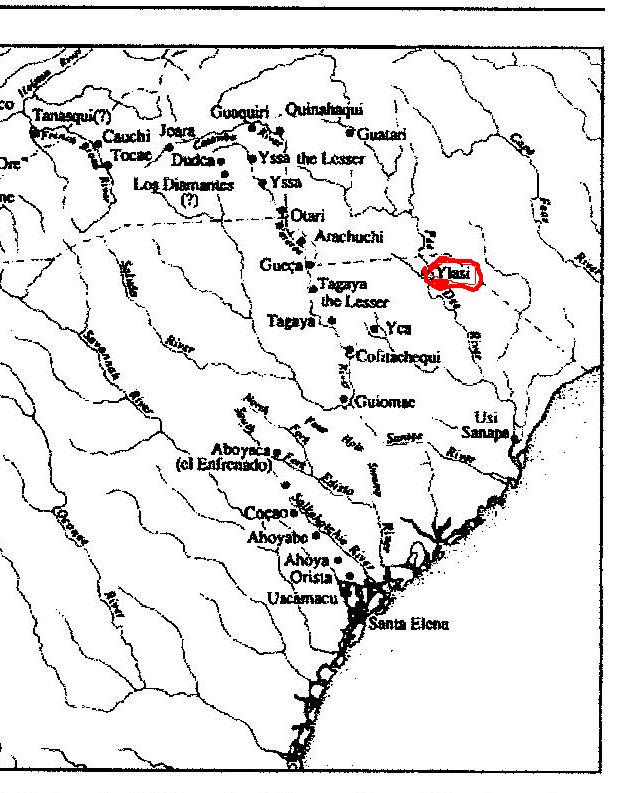
Were these early explorers in Tennessee?  Maybe. We do know that most people who have studied them have deAyllon at the Winyah Bay in South Carolina, and deSoto and Pardo on the Pee Dee River in South Carolina where we find these people known as Melungeons living as early as 1735.


Red indicates town where both deSoto and
Pardo visited. Pee Dee drains into Winyah Bay where
 Lucas deAyllon was found in 1526


In 1848 the ancestry of the Melungeons were published in dozens of newspapers across the country. In 1890 Will Allen Dromgoole went to Newman's Ridge and wrote of the same ancestry.  Indians who had mixed with Portuguese, blacks and whites. Her articles were published not all over the county but also across the seas. How did they become mysterious? They did not forget who they were, they did not make up a story to hide any ancestry and there was nothing mysterious about them and there still isn't.


The caravel ship introduced in the mid-15th century
which aided Portuguese exploration
Photo by Brazilian Navy

Portuguese discoveries is the name given to the intensive maritime exploration by the Portuguese during the 15th and 16th centuries. Portuguese sailors were at the vanguard of European overseas exploration, discovering and mapping the coasts of Africa, Asia and Brazil, in what became known as the Age of Discovery. Methodical expeditions started in 1419 along West Africa's coast under the sponsorship of prince Henry the Navigator, with Bartolomeu Dias reaching the Cape of Good Hope and entering the Indian Ocean in 1488. Ten years later, Vasco da Gama led the first fleet around Africa to India, arriving in Calicutand starting a maritime route from Portugal to India. Soon, after reaching Brazil, explorations proceed to southeast Asia, having reached Japan in 1542.  (Wikipedia)
By the time Jamestown was founded, the Portuguese had been running an Atlantic -- and worldwide -- empire for a century.  Portugal had colonies and outposts on both sides of the Atlantic Ocean and on islands in between and traveled the Atlantic freely.

Beside the Portuguese there are records of Armenians, East Indians, Spanish, Turks, and others in Colonial America. Boatloads of French, Germans, and Swiss. Yet these researchers today sitting in front of their monitors with all of these facts available with a click of the mouse and still they want to make the Melungeons 'mysterious' and make their Portugeuse ancestry a cover story. The Portuguese and their Portuguese Atlantic Creole offspring were sailing all over the Atlantic Ocean and the world but couldn't find their way to America?  Really?

Do these researchers, authors, bloggers have proof these people were something other than Portuguese? No.  They have tested the male DNA of a small sampling of people found in Hancock County which represents ONE ancestor out of thousands and have limited their study to Hancock County families when it is well documented there were pockets of these tawny people living elsewhere.  Furthermore, that DNA was found to be a mix of European and Sub-Saharan haplogroups which could easily have originated with people calling themselves Portuguese.

To put this in perspective we have the Portuguese and Portuguese Atlantic Creoles sailing all over the Atlantic, and we at least three expeditions in the 1500s on the Pee Dee River in South Carolina of Spanish, Portuguese and their slaves who interacted with the Natives in that area.

We have documentation these people who eyewitnesses said were Portuguese Indians were living on the Pee Dee River as early as 1725. These are the same people who went over the mountains in early 1800 to Hancock County and spread out from there.

We have no proof they were anything other than what they said they were.  Some of these researchers will scoff at the above evidence.  They laugh at old court records and testimony of the eyewitness' to history and at the same time cannot produce court records or eyewitness' to history to say they were anything else.

This is not about denying African ancestry. It is there, they themselves said it was there in 1848. One family that shows a male with African DNA does not tell you the history of that family, nor does it mean that all other lines, including the direct female lines could not have been Portuguese/Spanish, Indian or anything else.  Male DNA testing proves nothing but who is related to who and where their one ancestor came from thousands of years ago. 

It would appear the 'one drop rule' is alive and well today.  When Paul Heinegg was told William Chavis was a Saponi Indian his reply was;  he couldn't be an Indian, he was black, thus resorting to a false dichotomy.

Occam's Razor - "The principle states that among competing hypotheses, the one with the fewest assumptions should be selected."  We do not have to assume anything when we look at the 1500 expeditions of Spanish and Portuguese explorers -- they were there.  We do not have to assume they were on the Pee Dee River, there are records.  We do not have to assume the Melungeons 'might have' been on the Pee Dee River, there are records. And we do not have to assume they were Portuguese, they said they were and the records say they were. We do not have to assume these are the same people that came over the mountains and were called Melungeons, there are records. 

The KISS principle states "most systems work best if they are kept simple rather than made complicated". So why do these researchers want to keep complicating things?  Why do they insist this was a cover story when they said they were Portuguese and in the same breath they had mixed with the blacks and whites?  

Why do they want to make the Melungeons all of anything?  These families were mixed from the beginning and mixed as time went on.  Mixed with Africans, other tribes, Swiss, French, Germans, etc. Every family has a different make up.  DNA is never going to prove anything except who is related to who and that these families were mixed. Why the insistence on assuming they were anything but what they freely said there were:  Portuguese Indians who mixed with the black and whites forming the 'present race' in 1848?

There are many interesting articles at the Melungeon Indian Website 

These are some links from the website and the blog referenced in this article.

Early  Contacts

Early Melungeon Researchers

Africans - Portuguese Mixt Crew & Melungeons

Melungeons and The Smithsonian Institute

The Portuguese, DeSoto, The Indians & The Mixed Bloods


Historical Articles - Wayback Machine

  T hese are excerpts from old newspapers and magazines.  Click on the link at the end of the paragraph to read the entire article. Gen. Com...