Tuesday, February 17, 2015

Making the Blog More Interactive

 Making the Blog More Interactive

Joanne Pezzullo has long authored her excellent Melungeon blog and web site, and lately I've joined her blog as a co-author with a few modest contributions of my own. But we are not receiving nearly enough input from the person whose opinion matters to us the most. Which would be you!

If you have any requests for future articles, questions you'd like answered, suggestions for new blog features, or any other comments, please let us us know! The two best ways to do this are:

One; Write to us at: melungeon-blog@outlook.com

Two: Comment on our Facebook page:  ThePeopleCalledMelungeons

 Of course you can always simply comment on this or any other blog post!

Thank you!!

Wednesday, February 11, 2015

The Best of - Will Allen Dromgoole

The Mysterious Tribe Known as Melungeons

On the Ridge, the real stronghold of this peculiar people, life is a great deal harder than in the swamp or on Blackwater creek.  They live more like Indians than the dwellers in the valley, and are entirely content with their life.  I visited several huts, spending a month among them, living on corn bread, honey and black, sugarless coffee.  They were as utter strangers the day I left as on the day I arrived among them.

 The Saponi village was a musket shot from Fort Christiana (which taught 77 children), the village cabins were all joined making a circle with
3 passages 6 feet wide each, the doors all faced inside the circle
 while the center of the circle was a tree stump which the 12 head men spoke on.


 Calloway Collins in an Indian if ever one set foot on Tennessee soil.  He is very fond of his red skin, high cheek-bones and Indian like appearance.  His cabin has two rooms, connected by a kind of shed.  There are dirt floors in one room and the shed, but the other room has a floor of oak logs with the bark still on them and laid side by side, just as they came from the forest.  A bed of dry, last year's leaves was the only furnishing the room could boast.

The cooking and eating were done in the connecting shed, and a large coffee-pot always occupied a low shelf just above the table, for Calloway, like most of the Malungeons, is a slave to coffee and drinks it instead of water throughout the day and night.  Calloway himself is a king, a royal good fellow, who, seated upon a great stump that marks the fate of a giant beech that grew precisely in the center of the site selected by the Indian for his shed, or hallway,  would entertain me by the hour with his songs and banjo-picking and stories of his grandfather.

The man's very instincts are Indian.  He sleeps in leaves, inside or out, as he feels inclined.  He smokes almost unceasingly; so often, in fact, that his wife, Ann Calloway, finds it necessary to cultivate a 'torbacy spot'' for her ''ole man ter smoke up.''

THE MALUNGEONS

The records show that by act of the Constitutional Convention of 1834, when the “Race Question” played such a conspicuous part in the deliberations of that body, the Malungeons, as a “free person of color,” was denied the right of suffrage. Right there he dropped from the public mind and interest. Of no values as a slave, with no voice as a citizen, what use could the public make of the Malungeon?

In appearance they bear a striking resemblance to the Cherokees, and they are believed by the people round about to be a kind of half-breed Indian.
In Western and Middle Tennessee the Malungeons are forgotten long ago. And indeed, so nearly complete has been the extinction of the race that in but few counties of Eastern Tennessee is it known. In Hancock you may hear them and see them almost the instant your cross into the county line. There they are distinguished as the Ridgemanites or “pure Malungeons.” There among whom the white or negro blood has entered are called the Black Waters.”

Their complexion is a reddish brown, totally unlike the mulatto. The men are very tall and straight, with small sharp eyes, high cheek bones, and straight black hair, worn rather long. The women are small, below the average height, coal black hair and eyes, high cheek bones, and the same red-brown complexion. The hands of the Malungeon women are quite shapely and pretty. Also their feet, despite the fact that they travel the sharp mountain trails barefoot, are short and shapely. Their features are wholly unlike those of the negro, except in cases where the two races have cohabited, as is sometimes the fact. These instances can be readily detected, as can those of cohabitation with the mountaineer; for the pure Malungeons present a characteristic and individual appearance. On the Ridge proper, one finds only the Pure Malungeons; it is in the unsavory limits of Black Water swamp and on Big Sycamore Creek, lying at the foot of the Ridge between it and Powell’s Mountain, that the mixed races dwell.

LAND OF THE MELUNGEONS

Many of the Malungeons claim to be Cherokee and Portuguese. Where they could have gotten their Portuguese blood is a mystery. The Cherokee is easily enough accounted for, as they claim to have come from North Carolina, and to be a remnant of the tribe that refused to go when the Indians were ordered to the reservation. They are certainly very Indian-like in appearance. The men are tall, straight, clean-shaven, with small, sharp eyes, hooked noses, and high cheek bones. They wear their hair long ( a great many of them) and evidently enjoy their resemblance to the red man. This is doubtless due to the fact that a great many are disposed to believe them mulattos, and they are strongly opposed to being so classed. The women are small, graceful, dark and ugly. They go barefooted, but their feet are small and well shaped. So, too, are their hands, and they have the merriest, most musical laugh I ever heard. They are exceedingly inquisitive, and will ask you a dozen questions before you can answer two.

A STRANGE PEOPLE

The ridge proper is the home of the Malungeons. I visited one house where the floors were of trees, the bark still on them, and the beds of leaves.  The owner was a full-blooded Indian, with keen, black eyes, straight black hair, high cheeks, and a hook nose. He played upon his violin with his fingers instead of a bow, and entertained us with a history of his grandfather, who was a Cherokee chief, and by singing some of the songs of his tribe. He also described the Malungeon custom of amusements.

I also visited the cabin of a charmer, for you must know these people have many superstitions. This charmer can remove warts, moles, birth-marks, and all ugly protuberances by a kind of magic known only to herself. She offered to remove the mole from my face for 10 cents, and became quite angry when I declined to part with my lifetime companion. “Tairsn’t purty, nohers,” she said; “an ‘t air ner sarvice, nurther.” I cannot spell their dialect as they speak it. It is not the dialect of the mountaineers, and the last syllable of almost every word is omitted. The “R” is missing entirely from their vocabulary.

There is also a witch among them who heals sores, rheumatism, “conjures,” etc. They come from ten miles afoot to consult her.  They possess many Indian traits, that of vengeance being strongly characteristic of them. They, likewise, resemble the negro in many things.

THE FOUR BRANCHES

Somewhere in the eighteenth century, before the year 1797, there appeared in the eastern portion of Tennessee, at that time the Territory of North Carolina, two strange-looking men calling themselves "Collins" and "Gibson". They had a reddish brown complexion, long , straight , black hair, keen, black eyes, and sharp, clear-cut features. They spoke in broken English, a dialect distinct from anything ever heard in that section of the country.

They claimed to have come from Virginia and many years after emigrating, themselves told the story of their past. These two, Vardy Collins and Buck Gibson, were the head and source of the Melungeons in Tennessee. With the cunning of their Cherokee Ancestor, they planned and executed a scheme by which they were enabled to "set up for themselves" in the almost unbroken Territory of North Carolina.  This story I know is true. There are reliable parties still living who received it from old Vardy himself, who came here as young men and lived, as the Melungeons generally did to a ripe old age.

The original Collins people were Indian, there is no doubt about that, and they lived as the Indians lived until sometime after the first white man appeared among them. All would huddle together in one room, sleep in one common bed of leaves, make themselves such necessary clothing as nature demanded, smoke, and dream away the good long days that were so dreamily delightful nowhere as they were on Newman's Ridge.

The Collins, as I said; those who followed the first-comers accepting the name already provided them. There was no mixture of blood: they claimed to be Indians and no man disputed it. They were called the "Collins Tribe" until having multiplied to the extent it was necessary to divide, when the descendants of the several pioneers were separated, or divided into clans.

Then came the Ben clan, the Sol clan, the Mitch clan, and indeed every prominent head of a large relationship was recognized as the leader of his clan, which always bore his name. There was, to be sure, no set form or time at which this division was made. It was only one of those natural splits, gradual and necessary, which is the sure result of increasing strength.

They were still, however, we must observe, all COLLINSES, The main tree had not been disturbed by foreign grafting, and while all were not blood descendants of old Vary they, at all events, had all fallen under his banner and appropriated his name.

The tree at last began to put forth branches, or rather three foreign shoots were grafted into the body of it; the English...or whites....Portuguese....and African.
The English branch began with the MULLINS tribe, a very powerful tribe, next indeed for a long time to the Collins tribe, and at present the strongest of all the several branches, as well as the most daring and obstinate.

Old Jim Mullins, the father of the branch, was an Englishman, a trader, it is supposed, with Indians. He was of a roving, daring disposition, and rather fond of the free abandon which characterized the Indian. He was much given to sports, and was always "cheek to fowl" with the Cherokees and other Indian tribes he like to mingle. What brought him to Newman's Ridge must have been, as it is said, his love for freedom and sport, and that careless existence known only to the Indians.

He stumbled upon the Ridge settlement, fell in with the Ridgemanites, and never left them. He took for a wife one of their women, a descendant of old Sol Collins, and reared a family known as the MULLINS tribe. This is said to be the first white blood that mingled with the blood of the dusky Ridgemanites.
The Mullins tribe became exceedingly strong, and remains today the head of the Ridge people. The African branch was introduced by one Goins who emigrated from North Carolina after the formation of the state of Tenn. Goins was a Negro, and did not settle upon the Ridge, but lower down the Big Sycamore Creek in Powell's Valley.

He took a Melungeon woman for his wife (took up with her),and reared a family or tribe. The Goins family may be easily recognized by their kinky hair ,flat nose and foot, thick lips, and a complexion totally unlike the Collins and Mullins tribes. They possess many Negro traits, too, which are wanting to the other tribes.

The Portuguese branch was for a long time a riddle, the existence of it being stoutly denied. It has at last, however, been traced to one "Denham", a Portuguese who married a Collins woman.

It seems that every runaway or straggler of any kind whatever, passing through the country took up with abode temporarily or permanently, with the Melungeons, or as they were then called the Ridgemanites. They were harmless, social, and good-natured when well acquainted with one--although at first suspicious, distant, and morose. While they have never encouraged emigration to the Ridge they have sometimes been unable to prevent it.

Denham, it is supposed, came from one of the Spanish settlements lying further to the south. He settled on Mulberry Creek, and married a sister of Old Sol Collins.

There is another story, however, about Denham. It is said that the first Denham came as did the first Collins from North Carolina, and that he (or his ancestors) had been left upon the Carolina coast by some Portuguese pirate vessel plying along the shore.

So we have the four races or representatives among, as they then began to be called, the Melungeons; namely, the Indians, the English, the Portuguese, and the African. Each is clearly distinct and easily recognized even to the present day.
This , then, is the account of the Melungeons from their first appearance in that part of the country where they are still found .......


And this is the Melungeons according to Will Allen Dromgoole - 1890.  Her research has been accepted as early as 1890 when the U.S. Census Bureau wrote her account into the "Indians Taxed and Not Taxed" report, until the recent 2012 Melungeon paper publshed by Estes, Crain, Goins and Ferguson.

The "Legend of the Melungeons" as pubished in 1848 gave their history.  They were, they said, Portuguese Adventurers who mixed with the Indians and upon migrating to Tennessee had mixed with the whtes and blacks to form their present race.  They didn't lie, didn't leave out the 'black' and didn't try to 'hide their ancestry'.  They gave the 'Four Branches' just as they told this to William Allen Dromgoole forty some years later.

Their story has yet to be written, stalled by books, papers, etc., researchers  rewriting their history, providing 'mysterious ancestries' and connections and ignoring who these people said they were for more than fifty years.

DNA is now proving their story to be true. The Goins do, in fact, carry the Sub Saharan ancestry. Vardy Collins (R1a)  and Buck Gibson (R1b) DNA has came back European.  "Varieties of R1b, a common Y-DNA haplogroup in western Europe, are found in abundance among Portuguese men. About 60 percent of Southern Portuguese and about 83 percent of Northern Portuguese belong to the subclade of R1b known as the Atlantic Modal Haplotype (AMH). There are even some areas in Portugal where the AMH is found in about 90% of men." [Portuguese Genetics]

Records have been uncovered proving the Indian ancestry of the Gibsons as well as the Native DNA of the Sizemore, Helton, Hooker, Riddle, Freeman and others. Many of these descendants of Collins, Gibson, etc., are indeed showing the Native American blood in their autosomal DNA results.

Records found recently have uncovered little pockets of these Portuguese people lving in regions other than Newmans Ridge.  Melungeon research has came a long way in the last 15 years shredding just about everything that has been written about them since the 1940s, making earlier research outdated.
Perhaps the next 15 years will provide us with more answers, perhaps I will have to once again shift my research to a new area but that's alright, as long as their real story gets told.

Will Allen Dromgoole - Articles 

THE MELUNGEON INDIANS  Click Here
Historical Articles
Research
Genealogy

Monday, February 9, 2015

Will Allen Dromgoole


Boro Poet Dromgoole Helped Bridge Generations 
By Mike West
  
Murfreesboro Post
February 9, 2009

During her life, Will Allen Dromgoole was a prolific writer and poet.

While she wrote more than 7,500 poems, 5,000 essays and published 13 books, her most famous poem was “The Bridge Builder.”

Written around 1900, “The Bridge Builder” is often reprinted and quoted by motivational speakers, pastors and even the Boys Scouts. Its words grace a number of real bridges like the Bellows Fall bridge in Connecticut.

Dromgoole, 1860-1934, was born in Murfreesboro, the last child of John Easter and Rebecca Blanche Dromgoole. Her father was mayor during the Civil War and often found himself negotiating between locals and the Federal troops occupying the town.

Dromgoole changed her middle name to Allen when she was 6, and throughout her life was known as Will Allen or "Miss Will." In 1876 Dromgoole graduated from the Clarksville Female Academy and studied at the New England School of Expression in Boston.           

She began her writing career after the death of her mother and will caring for her aging father.

She published her first novel, “The Sunny Side of the Cumberland,” under the name Will Allen in 1886. Her first short story was published that same year and awarded a cash prize by Youth's Companion in 1886.

Her life then took an unusual twist for the day. She studied law with her father and won terms as engrossing clerk for the Tennessee State Senate. But an unflattering series of articles she wrote about the Melungeons of East Tennessee caused her defeat in 1889 and 1891 and she relocated to Texas where she wrote for newspapers.

She returned to Tennessee in 1897 and was hired in 1902 as a staff writer for the Nashville Banner, where she wrote a popular column, “Song and Story” for 31 years.

With the outbreak of World War I, Dromgoole became one of the first (if not the first) women to join the U.S. Navy where she served as a yeoman warrant officer at Norfolk, Va.

She returned to the staff of the Banner in 1918 where she worked until her death in 1934.

Dromgoole is buried in the Evergreen Cemetery in Murfreesbor.

Her poem still often quoted:

The Bridge Builder
By Will Allen Dromgoogle

An old man, going a lone highway,
Came, at the evening, cold and gray,
To a chasm, vast, and deep, and wide,
Through which was flowing a sullen tide.
The old man crossed in the twilight dim;
The sullen stream had no fear for him;
But he turned, when safe on the other side,
And built a bridge to span the tide.

Old man,” said a fellow pilgrim, near,
“You are wasting strength with building here;
Your journey will end with the ending day;
You never again will pass this way;
You've crossed the chasm, deep and wide-
Why build you this bridge at the evening tide?”

The builder lifted his old gray head:
“Good friend, in the path I have come,” he said,
“There followeth after me today,
A youth, whose feet must pass this way.
This chasm, that has been naught to me,
To that fair-haired youth may a pitfall be.
He, too, must cross in the twilight dim;
Good friend, I am building this bridge for him.”


And she wrote about Melungeons.  Quite a lot, in fact.  More on that to follow!

Friday, February 6, 2015

The Black-and-White World of Walter Ashby Plecker

By WARREN FISKE

The Virginian-Pilot
August 18, 2004

Lacy Branham Hearl closes her eyes and travels eight decades back to what began as a sweet childhood.

There was family everywhere: her parents, five siblings, nine sets of adoring aunts and uncles and more cousins than she could count. They all lived in a Monacan Indian settlement near Amherst, their threadbare homes circling apple orchards at the foot of Tobacco Row Mountain.As Hearl grew, however, she sensed the adults were engulfed in deepening despair. When she was 12, an uncle gathered his family and left Virginia, never to see her again. Other relatives scattered in rapid succession, some muttering the name "Plecker."

To Continue Reading, Click Here.

Tuesday, February 3, 2015

Walter Plecker and His Melungeon Hitlist

Walter Plecker's writings on Melungeons and his infamous Melungeon name list:

To Read, Click Here!!

Do bear in mind that Melungeons were just one among his many targets.  The cultural damage -- and documentary genocide -- he inflicted upon Virginia's Indians continues to haunt them to this day:


Richmond Times Dispatch
1-29-1926
CHIEF COLLAPSES AS HE PLEADS FOR RACE PROTECTION
PAMUNKEY LEADER FALLS OUT AFTER SPEECH ASSAILING RACIAL INTEGRITY BILL
SAYS JOHN SMITH SPIRIT IS MISSING
Chief Cook Denies Kin With Heathen Race -- No Action Taken
By William G. Southall

Chief Cook of the Pamunkey Indians last night literally fell on the field of battle in a verbal clash with his paleface neighbors.

The aged man took the floor to protest before the House Committee and General Laws against the provision of the Norris racial integrity bill which classified as colored all Virginians who are not pure white. 

“I am a sick man,” he said.  “I left a sick-bed,” he said to come here for the speech I shall make.  It may be that I shall go down in the effort. It makes no difference. I told my people that I would be in Richmond for this hearing if it meant that I should be carried back home in a baggage.  I would die for the Pamunkey tribe.

A Natural Orator

The chief is a natural orator. His is an inherited gift.  Indians have been noted for their picturesqueness of speech since they took over the language of the white man,  The leader of the Pamunkeys last night was impressive as he stood in the Virginia Capitol and pleaded for the preservation of his tribe.  His voice broke at time but always he recovered it and continued his impassioned address.

After he had concluded he went slowly back to his seat in the rear of the hall.  An advocate on the other side of the question propounded an inquiry.  The chef did not answer.  Two or three men came to his side discovered that he was exhausted and assisted him to a long seat upon which he might lie.  Aromatic spirits of ammonia were administered, and the Pamunkey leader finally regained his lost strength.

At times the chief’s speech was tinged with bitterness.

“You talk of granting us land” he cried.  “Do you bring with you from across the sea on foot of soil?  Was not all Virginia ours when you came here?  Some of you boast of being F. F. V’s. I do not. I say that I come from the First Families of America.

God Fearing Folk

“Tell me, would you blot out a nation? God forbid! The charge has been made that we were from the heathen race.  I deny it from the bottom of my soul. We come from  God-fearing folk.  Long before we new the palefaces the Great Spirit brooded over us and died in the belief that we should join our brothers in the Happy Hunting Grounds.”

“Who would have thought.” he concluded dramatically, “that the heart of Captain John Smith, who would “have destroyed all the Pamunkeys, beat in the breasts of the palefaces of this day.?”

Defines White Person

At 12:30 o’clock this morning the committee rose without taking any definite action.

The bill under consideration last night differs from the law enacted at the 1924 session of the Assembly principally in that it defines a white person as one who has not one drop of other blood in his veins, except that persons who trace themselves back to a marriage union between a white person and an Indian contracted prior to 1619, or who have in them an admixture of the blood of Indians belonging to the civilized tribes of Oklahoma or Texas, shall be regarded as white.  All others are to be classified as colored.

This is the objection raised to the bill by the Pamunkey, the Chickahominy, the Mataponi and the Rappahannock tribes.  They would consent, they said, to a law forbidding any intermarriage among the races and providing the severe punishment for violation of the statue.

Opponents of the measure before the House Committee proposed an amendment which would define white, Indian and colored persons.  This suggestion met determined opposition from Dr. W. A. Plecker, Registrar of Vital Statistics, and John Powell; who has labored indefatigably for several years in the cause of racial integrity.  They made the point that thousands of persons whom they regard as mulattos would come forward with the claim of Indian descent, all of whom must be investigated.  Such a burden, they said, would be too much for the department to carry and function efficiently the while.

Recognition of also three races would be out of line with the policy obtaining elsewhere, and would serve no other purpose than to throw out of joint all the machinery of classification.

Dr. Plecker Opens Discussion

Dr. Plecker who holds that there is no Indian in Virginia who does not carry in his veins some negro blood, opened the discussion with a brief explanation of the bill.  Speakers on his side of the question included Delegate Warren, of Portsmouth: Mrs. Fothergill, who was presented as a genealogist; John Powell and Major E. S. Cox.

Representing the opponents of the measure where Senator Douglas Mitchell, who appeared in behalf of the Pamunkeys; Manley H. Barnes, for the Chickahominies George Haw, also for the Chickahominies; Judge Fleet for the Rappahonnocks; M.D. Hart, Roger Gregory, Rev. Mr. Sudduth, Chief George Nelson of the Rappahannocks, and James H. Johnson, a member of that tribe.

Monday, February 2, 2015

Walter Plecker: Master of Documentary Genocide

Documentary Genocide:
Families Surnames on Racial Hit List

By Peter Hardin, Times-Dispatch Washington Correspondent Sunday,March 5, 2000

Long before the Indian woman gave birth to a baby boy, Virginia branded him with a race other than his own.

The young Monacan Indian mother delivered her son at Lynchburg General Hospital in 1971. Proud of her Indian heritage, the woman was dismayed when hospital officials designated him as black on his birth certificate. They threatened to bar his discharge unless she acquiesced. The original orders came from Richmond generations ago.

Virginia’s former longtime registrar of the Bureau of Vital Statistics, Dr. Walter Ashby Plecker, believed there were no real native-born Indians in Virginia and anybody claiming to be Indian had a mix of black blood.

In aggressively policing the color line, he classified “pseudo-Indians” as black and even issued in 1943 a hit list of surnames belonging to “mongrel” or mixed-blood families suspected of having Negro ancestry who must not be allowed to pass as Indian or white.

With hateful language, he denounced their tactics.

” . . . Like rats when you are not watching, [they] have been `sneaking’ in their birth certificates through their own midwives, giving either Indian or white racial classification,” Plecker wrote.
Twenty-eight years later, the Monacan mother’s surname still was on Plecker’s list. She argued forcefully with hospital officials. She lost.

Today, the woman’s eyes reveal her lingering pain. She consulted with civil rights lawyers and eventually won a correction on her son’s birth certificate.

“I don’t think the prejudice will ever stop,” said the woman, who agreed to talk to a reporter only on condition of anonymity.

She waged a personal battle in modern times against the bitter legacy of Plecker, who ran the bureau from 1912 to 1946. A racial supremacist, Plecker and his influential allies helped shape one of the darkest chapters of Virginia’s history. It was an epoch of Virginia-sponsored racism.

A physician born just before the Civil War, Plecker embraced the now-discredited eugenics movement as a scientific rationale for preserving Caucasian racial purity. He saw only two races, Caucasian and non-Caucasian, and staunchly opposed their “amalgamation.”

After helping win passage in 1924 of a strict race classification and anti-miscegenation law called the Racial Integrity Act, Plecker engaged in a zealous campaign to prevent what he considered “destruction of the white or higher civilization.”

When he perceived Indians as threats to enforcing the color line, he used the tools of his office to endeavor to crush them and deny their existence.

Many Western tribes experienced government neglect during the 20th century, but the Virginia story was different: The Indians were consciously targeted for mistreatment.

Plecker changed racial labels on vital records to classify Indians as “colored,” investigated the pedigrees of racially “suspect” citizens, and provided information to block or annul interracial marriages with whites. He testified against Indians who challenged the law.

Virginia’s Indians refused to die out, although untold numbers moved away or assumed a low profile. Now, eight surviving tribes recognized by Virginia in the 1980s are preparing to seek sovereign status from the U.S. government through an act of Congress. About 3,000 of the 15,000 Indians counted in Virginia in the 1990 census were indigenous to the state, experts say.

As they bid for federal recognition, more Indian leaders are talking openly about the injustice of Plecker’s era. They gave a copy of his 1943 “hit list” to Virginia members of Congress along with other data in support of their bid.

Modern scholars have studied Plecker and the racial integrity era. Their findings contributed to this article. Yet he’s not widely known today.

“It’s an untold story,” said Oliver Perry, chief emeritus of the Nansemond Tribe.

“It’s not that we’re trying to dig him up and re-inter him again,” said Gene Adkins, assistant chief of the Eastern Chickahominy Tribe.

“We want people to know that he did damage the Indian population here in the state. And it’s taken us years, even up to now, to try to get out from under what he did. It’s a sad situation, really sad.”
Said Chief William P. Miles of the Pamunkey Tribe: “He came very close to committing statistical genocide on Native Americans in Virginia.”

Chief G. Anne Richardson of the Rappahannock Tribe spoke bluntly: “Devastation. Holocaust. Genocide."

“Those are the words I would use to describe what he did to us,” she said. “It was obvious his goal was the demise of all Native Americans in Virginia. . . . We were not allowed to be who we are in our own country, by officials in the government.”

For people of Indian heritage, Plecker’s name “brings to mind a feeling that a Jew would have for the name of Hitler,” said Russell E. Booker Jr., Virginia registrar from 1982 to 1995. That view “certainly is justified.”

Indeed, one of Plecker’s most chilling letters mentioned Adolf Hitler - and not unfavorably.
“Our own indexed birth and marriage records showing race reach back to 1853,” Plecker wrote U.S. Commissioner of Indian Affairs John Collier in 1943. “Such a study has probably never been made before.

“Your staff member is probably correct in his surmise that Hitler’s genealogical study of the Jews is not more complete.”

Plecker also used haunting rhetoric in publishing a brochure on “Virginia’s Vanished Race” a month before his death in 1947. He asked, “Is the integrity of the master race, with our Indians as a demonstration, also to pass by the mongrelizations route?”

Confronting an Era

On wooded Bear Mountain, miles up a country road outside Amherst, a visitor finds more evidence of the new willingness to confront Plecker’s era head-on.

It’s the historical center of the Monacan Indian Nation. A one-room log schoolhouse dating to the 1870s is standing. Also there are a simple white church and a small ancestral museum with a new sign proclaiming “History Preserved is Knowledge Gained.”

Tribal activist and researcher Diane Shields digs into her files and pulls out for a visitor a dozen manila folders with photocopies of Plecker’s letters covering two decades.

The Monacans acknowledge the stigma and pain, the second-class status, the lack of economic opportunity and the inferior education inflicted upon them and other Virginia tribes.

Indian children were relegated to substandard “colored” schools. Their parents, wanting to keep an Indian identity, often declined to send them there. Some tribal children studied in lower grades at reservation schools or church-sponsored schools like the one at Bear Mountain.

Even in this history of oppression, some Monacans have found a value: a common identity.
“It’s a horrible thing, what he did to the Indian people,” Shields said of Plecker. “But you know what? It gives me a sense of belonging - because I’m grouped with my own people.

“It kind of backfired with Plecker. He pushed the Indian people closer and gave us an identity.”
Her brother, Johnny Johns, is a tribal leader and electrical technician. He’s 51. Enrolled at Lynchburg College at midlife, he’s been learning about the eugenics movement. Johns, whose surname was on Plecker’s “hit list,” regards him in two ways.

First, there’s “the horror, the terror.” Yet he believes Plecker “did us a favor, because the list of [Indian] names is there. We know who we are. It’s a two-edged sword, a duality.”

Monacan Chief Kenneth Branham, 47, remembers shunning by whites when Indian children were first allowed into public elementary school in the 1960s. School bus drivers sometimes refused to transport them.

Plecker was cruel, Branham believes. But “he kind of drew us together. We were a tightknit group, because there was nobody else we could associate with.”

His tribe, which has grown dramatically in recent years to about 1,100 enrolled members, is using federal grant money to document its history. The Monacans are making their comeback with people like Shields and Johns, who were drawn back from beyond Virginia to their family and tribal roots, the place they now call home.

Among them is Indian activist Mary B. Wade, who learned only in the late 1980s about her Monacan heritage from an uncle in Maryland. Now she’s secretary of the Virginia Council on Indians, a state government advisory panel.

The Monacan tribe owns more than 100 acres on and near Bear Mountain and dreams of buying hundreds more, developing a retirement home and a day-care center.

These Amherst Indians won recognition from the General Assembly in 1989, five years after Lynchburg pediatrician Peter Houck laid out a Monacan genealogy for what was once called a lost tribe. Houck detailed his findings in a book, and the recognition has contributed to a spirit of resurgence among the Monacans.

Indian people of Amherst and adjoining Rockbridge counties were a special target of Plecker.
He wrote in a 1925 letter, “The Amherst-Rockbridge group of about 800 similar people are giving us the most trouble, through actual numbers and persistent claims of being Indians. Some well-meaning church workers have established an `Indian Mission’ around which they rally.”

Across the state in eastern Virginia, home for tribes that once made up the Powhatan Confederation, Plecker evokes diverse reactions from Indian leaders.
 
“He was just determined to get rid of us,” said Chief A. Leonard Adkins, 73, of the Chickahominy Tribe. “It was hard to believe that a man could do what he did and get away with it.”

A Chickahominy midwife was threatened by with imprisonment by Plecker if she didn’t stop putting `Indian’ on birth records, Adkins said. She decided to stop her midwifery rather than buckle under to him or risk a prison term.

During Plecker’s era, a number of Indians didn’t admit to their cultural heritage or pass down traditions to their children. It was easier for many to adapt to white society, said Chief Barry Bass of the Nansemond Tribe.

“There’s probably a lot who have gone to their grave who still didn’t admit they were Indian. That’s where it hurt,” said Bass, the acting chairman of the Virginia Council on Indians.

Plecker wrote in a 1924 state-published pamphlet, “Eugenics in Relation to the New Family,” that there were no true Indians in Virginia who didn’t have some black blood. He later refined this to apply to “native-born people in Virginia calling themselves Indians.”

His 1943 letter alluding to “rats . . . `sneaking’ in their birth certificates” claimed that mixed-blood groups were intent above all on “escaping negro status and securing recognition as white, with the resulting privilege of attending white schools and ultimately attaining the climax of their ambitions, marrying into the white race.”

Plecker misunderstood the Indians’ culture, said Dr. Helen C. Rountree, an anthropoligist and Virginia Indian expert recently retired from Old Dominion University. Those whom she studied in eastern Virginia believed that if they married a white, the children would be Indians, Rountree wrote in her book, “Pocahontas’s People.”

These Indians did not want to be “white,” she wrote, although they wanted access to the better facilities available to whites and the freedom to marry whites to avoid inbreeding.

In drawing his conclusions, Plecker relied heavily on old birth and death records that indicated only whether an individual was white or nonwhite, said former registrar Booker.

“There was no place to register `Indian.’ Nonwhite was later taken to mean black, by Plecker and by the Racial Integrity Act,” Booker said.

To Booker, the racial integrity era amounted to what today would be called “ethnic cleansing.” Or “documentary genocide.”

“He was convinced he was one of the chosen,” Booker said of Plecker. “He was the original martinet.”

The Plecker Letters

Plecker left a major paper trail.

He gave carbon copies of hundreds of his official letters, neatly typed on “Commonwealth of Virginia, Department of Health” stationery, to John Powell, a Richmond-born concert pianist and an outspoken advocate for race-purity measures in Virginia.

Today, the letters offer a rare record of a bureaucrat intruding in individual lives, harassing and intimidating citizens, bullying local officials and stamping out civil rights.

The correspondence is housed in a collection of Powell documents at the University of Virginia’s Alderman Library. Powell graduated Phi Beta Kappa from U.Va. at age 18. He became an internationally known pianist and lectured in U.Va.’s music department.

In one letter, Plecker wrote a Lynchburg woman in 1924 to correct a supposedly false birth report for her child, which had been signed by a midwife.

“This is to give you warning that this is a mulatto child and you cannot pass it off as white,” he wrote.

Plecker apprised her of the new “one-drop” rule, which defined a white person as having “no trace whatsoever of any blood other than Caucasian.”

“You will have to do something about this matter and see that this child is not allowed to mix with white children,” Plecker admonished. “It cannot go to white schools and can never marry a white person in Virginia. It is an awful thing.”

To a woman he knew to be from a “respectable” white family in Hampton, Plecker voiced surprise that she would ask about a license to marry a man of mixed African descent.

“I trust . . . that you will immediately break off entirely with this young mulatto man,” he wrote.

Plecker threatened a Fishersville woman with prosecution in 1944 for a birth record he contended hid her Negro lineage.

“After the war it is possible that some of these cases will come into court. We might try this one. It would make a good one if you continue to try to be what you are not,” Plecker warned.

His writing supports the view of leading scholars that Indians were a secondary, not primary, target of the eugenics movement in Virginia.

“The attack on persons of African descent laid the foundation for the attack against the American Indian community in Virginia as a mixed-race population,” wrote an anthropologist, Dr. Danielle Moretti-Langholtz of the College of William and Mary, in a dissertation on the political resurgence of Virginia’s Indians.

Plecker was vehement about preserving the color line.

“Two races as materially divergent as the white and the negro, in morals, mental powers, and cultural fitness, cannot live in close contact without injury to the higher,” he told an American Public Health Association session in 1924. “The lower never has been and never can be raised to the level of the higher.”

Plecker went on, “We are now engaged in a struggle more titanic, and of far greater importance than that with the Central Powers from which we have recently emerged,” he added. “Many scarcely know that the struggle which means the life or death of our civilization is now in progress, and are giving it He concluded, “Let us turn a deaf ear to those who would interpret Christian brotherhood to mean racial equality.”

Rise to Power He had risen to become Virginia’s first registrar at a time when segregationist Jim Crow laws and attitudes already were securely in place in the South.

In the eugenics movement, Plecker and allies found a basis in “science” for their extremist thinking, according to scholars who have studied him.

Plecker was born April 2, 1861, in Augusta County. He died at age 86 in August 1947 when he failed to look before crossing the street on Chamberlayne Avenue in Richmond and was hit by a car.

Schooled at Hoover Military Academy in Staunton, he attended the University of Virginia and graduated with a degree in medicine from the University of Maryland in 1885. For about 25 years, he practiced as a country doctor. After joining the health department of Elizabeth City County, now the city of Hampton, he set up a system for keeping health records and vital statistics, earning that county a national reputation.

In 1912, he came to Richmond to help state officials organize the Bureau of Vital Statistics, and he was tapped as its first registrar. Births, deaths and marriages would have to be reported to the bureau.

“He was a pioneer in the health of the newborn,” said former registrar Booker, who as a youngster delivered the newspaper to Plecker’s Richmond home. “He wrote what I thought was an outstanding book for midwives.”

Plecker was drawn to the eugenics movement, which held that society and mankind’s future could be improved by promoting better breeding.

He was among eugenics adherents who believed in the supremacy of white genetic stock, the inferiority of other races and the threat that mixing with the white race would lead to decline or destruction.

To push for law to preserve “racial integrity,” Plecker teamed with Powell and Tennessee-born Earnest S. Cox, author of a book titled “White America.”

Powell was a leading founder of the Anglo-Saxon Clubs of America, an all-male, native-born group started in Richmond in September 1922 and a year later claiming to have 25 posts statewide. Plecker was a member.

Its goals were preservation of Anglo-Saxon ideals and “the supremacy of the white race in the United States of America without racial prejudice or hatred,” according to its constitution.

“This was the Klan of the aristocracy - the real gentleman’s Klan,” said J. David Smith of Longwood College, a eugenics expert.

Newspaper accounts at the time detailed a link with former Richmond KKK members. The Richmond Lodge of the KKK seceded in 1922 from the national organization, according to news accounts. A lawyer for some of the former Klansmen said the national group was judged to be a “rampant anti-Catholic organization instead of an organization to maintain white supremacy.”

“The Ku-Klux Klan in Richmond organized the Anglo-Saxon Clubs of America, and the local organization is known as Richmond Post, No. 1,” the lawyer went on to say in The Times-Dispatch.

Powell wrote in correspondence later that the Anglo-Saxon Clubs had “no connection whatever” with the KKK and were “in no sense unfriendly to the Negro.”

In 1924 the General Assembly adopted race-purity legislation championed by the Anglo-Saxon Clubs and promoted by Plecker, Cox and Powell. It would stand until a landmark 1967 ruling by the U.S. Supreme Court.

The Racial Integrity Act was one of the nation’s strictest. It defined white person for the first time, using the “one-drop rule,” and went beyond earlier state law against inter-marriage by making it illegal for whites to marry any nonwhites, including Asians.

However, the law permitted persons with one-sixteenth American Indian blood and “no other non-Caucasic blood” to be classified as white. That was a nod to descendants of Pocahontas, some of whom counted themselves among “first families” of Virginia.

Some leading state newspapers, including The Times-Dispatch and The Richmond News Leader, endorsed the race-purity goals.

The Times-Dispatch editorialized in 1924 that race intermingling would “sound the death knell of the white man. Once a drop of inferior blood gets in his veins, he descends lower and lower in the mongrel scale.”

This newspaper also gave Powell a platform, publishing two years later a 13-part series of his articles titled “The Last Stand” and describing what he called Virginia’s declining racial purity.

Plecker, meanwhile, lent support for black separatist Marcus Garvey’s back-to-Africa movement.

Plecker kept trying to narrow loopholes in the Virginia law. The legislature agreed in 1930 to define “colored” people as those “in whom there is ascertainable any Negro blood.”

Framers of the Racial Integrity Act found “a convenient facade” for their race prejudices in the “pseudo-science of eugenics,” said Paul A. Lombardo, a eugenics expert who teaches at the University of Virginia law school.

Lombardo wrote, “The true motive behind the [act] was the maintenance of white supremacy and black economic and social inferiority - racism, pure and simple.”

Enforcing the Act In his more than 30 years as registrar, Plecker stood up to those who disagreed with him, urged him to back off, or got in his way.

They included courageous Indians, a Virginia governor and federal officials.

Some people were imprisoned for violating the Racial Integrity Act, but a number of juries wouldn’t convict. There were legal challenges to the act and Plecker’s enforcement, but it took the U.S. Supreme Court in 1967 to void Virginia’s anti-miscegenation law.

Two of the earliest challenges came in Rockbridge County in 1924.

A circuit judge upheld in the first case the denial of a marriage license for an Indian woman to marry a white man. But in the second case, he set the eugenics backers reeling.

Judge Henry W. Holt heard expert testimony from Plecker before ruling in favor of an Indian woman who had challenged the denial of a license for her to wed a white man.

Holt found no evidence that the woman, Atha Sorrells, was of mixed lineage under a reasonable interpretation of the new law. He questioned its constitutionality and the legal meaning of the term Caucasian.

“Half the men who fought at Hastings were my grandfathers. Some of them were probably hanged and some knighted, who can tell? Certainly in some instances there was an alien strain. Beyond peradventure, I cannot prove that there was not,” he wrote in his opinion.

Drawing on “Alice in Wonderland,” he added, “Alice herself never got into a deeper tangle.”

John Powell shot back with a pamphlet, published by the Anglo-Saxon Clubs, titled “The Breach in the Dike: an Analysis of the Sorrels Case Showing the Danger to Racial Integrity from Intermarriage of Whites with So-Called Indians.”

Holt’s ruling was not appealed, however. An assistant state attorney general warned that the act might be declared unconstitutional.

Absalom Willis Robertson, the Rockbridge commonwealth’s attorney, represented the state. A former state senator, Robertson would rise to fame as a congressman and U.S. senator for 34 years. A conservative Democrat, he was known as an expert on federal finances.

On civil rights, Sen. Robertson opposed the progressive stands of the national Democratic Party and was involved in the filibuster over civil rights legislation in 1963. His son, Republican Pat Robertson, is the conservative television evangelist who founded the Christian Coalition and, in 1988, ran for president.

In an October 1924 letter, Plecker personally had asked A.W. Robertson to represent Virginia “if your charge is not too great, and the Governor will pay the bill.”

Gov. E. Lee Trinkle, too, had written Robertson. “Willis, this law is a new one and I regard it of vital importance. There are a great many of our real substantial white people who fought hard for the Bill and are doing all they can to help out in this situation over the State.”

Asking what Robertson would charge if he were to represent the state, Trinkle added, “I know that you will be more than reasonable because you, like the rest of us, are interested in this movement.”
When Plecker sought to have the race-purity law toughened the following year, the governor advised moderation.

Trinkle wrote Plecker, urging him to “be conservative and reasonable and not create any ill feeling if it can be avoided between the Indians and the State government.

“From reports that come to me,” Trinkle added, “I am afraid sentiment is moulding itself along the line that you are too hard on these people and pushing matters too fast.”

Plecker didn’t yield. The registrar tried to tell U.S. Census officials how to list Indians and urged Selective Service officials not to induct them as whites.

A number of Virginia Indians, struggling to retain their identity, battled to be inducted with whites in World War II, a position Plecker opposed. Through various petitions and channels, the Indians met inconsistent results.

Three Rappahannock men who refused induction with blacks were prosecuted and sentenced to prison, but they later were allowed to pass the war years by laboring in hospitals as conscientious objectors. Yet in a federal court in western Virginia, a judge sided with seven Amherst County Indians who resisted induction as Negroes.

Finally the government, after years of wrangling, generally deferred to registrants to choose their race, an Indian victory that some scholars believe helped pave the way for the civil rights movement.
In the same period, Plecker wrote a letter to Powell that reflected a defeat - and Plecker’s own authoritative gamesmanship.

Plecker had begun putting “corrections” on the backs of birth certificates issued by his bureau before 1924 to remove the designation “Indian.” A prominent Richmond attorney, John Randolph Tucker, representing two Amherst County Indians challenged Plecker’s standing to “constitute himself judge and jury” by making such a change and threatened court action.

Plecker yielded temporarily. “This is the worst backset which we have received since Judge Holt’s decision,” he confided to Powell on Oct. 13, 1942. “In reality I have been doing a good deal of bluffing, knowing all the while that it could not be legally sustained. This is the first time my hand has absolutely been called.”

The “backset” didn’t last long. The General Assembly voted in 1944 to allow the registrar to put on the backs of birth, death or marriage certificates data that would correct erroneous racial labels on the front.

Plecker died in 1947. But his legacy survived. Not until 13 years after the Warren Court’s landmark 1954 desegregation decision in Brown vs. Board of Education was the intermarriage ban in Virginia’s Racial Integrity Act overturned.

Saying Virginia’s anti-miscegenation law was based on racial distinctions, the Supreme Court concluded, “There is patently no legitimate overriding purpose independent of invidious racial discrimination which justifies this classification.

“The fact that Virginia prohibits only interracial marriages involving white persons demonstrates that the racial classifications must stand on their own justification as measures designed to maintain white supremacy.”

In 1975, Virginia repealed its racial definition and segregation laws.

Lasting Damage Virginia tribes preparing to seek federal recognition as sovereign nations have told officials in Washington about the lasting damage sustained in the Plecker era, three centuries after Virginia’s “first people” encountered the European settlers.

A bill being drafted by Rep. James P. Moran, D-8th, would ask Congress to grant federal recognition.
Gene Adkins of the Eastern Chickahominy said it may take beyond the current generation of Virginia Indians to correct the wrongs of Plecker’s era.

“We’re getting [more] advantages, but we still don’t have the same advantages today of the white population,” Adkins said.

Telling the story of Plecker’s mistreatment of the Indians could open more doors, Adkins said.
“It boils down to this: More people will be sympathetic to what we’re trying to do.”

Tuesday, January 27, 2015

Legends

 LEGENDS
by
Joanne Pezzullo & Dennis Maggard
OCCAM'S RAZOR  "The principle states that among competing hypotheses, the one with the fewest assumptions should be selected. Other, more complicated solutions may ultimately prove correct, but—in the absence of certainty—the fewer assumptions that are made, the better."
The KISS principle states "most systems work best if they are kept simple rather than made complicated.  Variations of KISS are "keep it short and simple" and "keep it simple and straightforward".
In 1848 a journalist from Kentucky with his accomplice  arrived in Vardy Valley where he was the guest of Vardy Collins, "Chief cook and bottle washer of the Melungens".  The story of his visit was published in dozens of newspapers across the country.

"The legend of their history, which they carefully preserve, is this. A great many years ago, these mountains were settled by a society of Portuguese Adventurers, men and women.... These intermixed with the Indians, and subsequently their descendants (after the advances of the whites into this part of the state) with the negros and the whites, thus forming the present race of Melungens."
He wrote the "Legend" as it was told to him, possibly by Vardy, however it does not say who the Melungens were, he doesn't have names and we are not even sure if Vardy did tell the legend if it was Vardy's legend or if it belonged to another group of people, the Portuguese Indians who had come over the mountains after the War of 1812 from the Pee Dee River area of South Carolina.

Over the years it has been suggested the Melungeons forgot who they were, didn't know their history, were mysterious, and most importantly 'said they were Portuguese as a cover story to hide their African ancestry'.

Here we have in 1848 Vardy Collins, known as that wily Cherokee, "head and source' of the Melungens telling this journalist they were Portuguese Indians, and they mixed with the whites and the blacks.  No mystery, knew who they were and where they came from. If they said they had mixed with the blacks then why oh why would Portuguese be a made up story to hide their 'black ancestry'?

This is the same story told to Will Allen Dromgoole in 1890, 40 some years later.

In genealogy we start with ourselves and go back each generation collecting documents and proving our ancestry.  Melungeon research is no different.  At the time this article was written in 1848 there were people called Melungens living in Hamilton and Wilson County in Tennessee as well as a group in Dothan, Albama.  The former two known as people with Portuguese ancestry by their neighbors and many proven in the court system from North Carolina to Texas. One yet to be identified appears to be a political group living near Richmond, Virginia in the 1850s and 60s known as Moulungeons.

Why the idea there were NO Portuguese people in Colonial America just simply defies logic.  Numerous researchers, historians etc., people who were neighbors to these people, and knew them and their ancestors, testified as to their Portuguese ancestry for over 100 years. Yet still today we read of the 'Mysterious Melungeons' and their 'cover story'. There are early records of  the 'Spanish Plantation' mentioned by John Smith in 1608, Fernando the Portuguese, Nicholas the Portuguese, Manuel the Portuguese, and 'the Portuguese found at Saponi town in 1671.  George, known only as 'the Spaniard' was living near Jamestown in 1669.

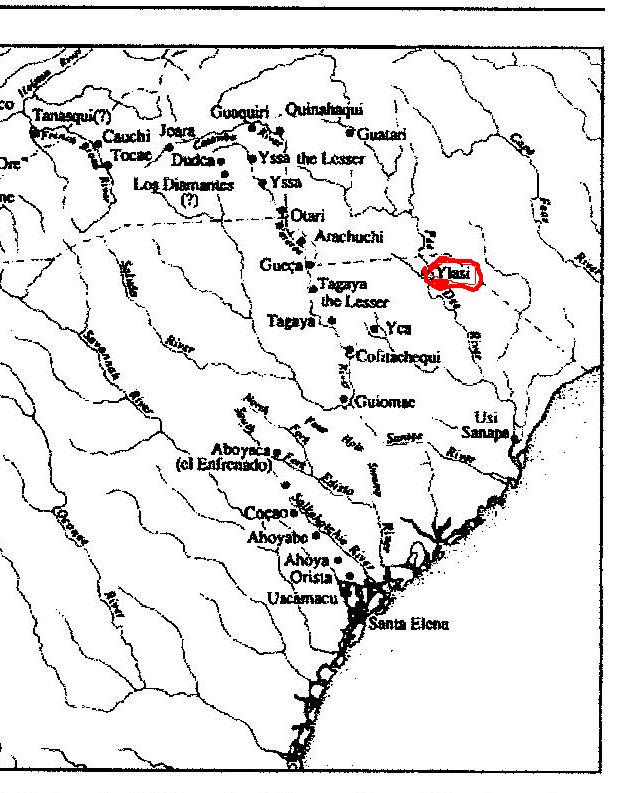
Back to these 'Melungeon' people known as Portuguese Indians. The first thing we look for 'is their any proof of Portuguese mixing with the Indians in early records' and the answer is yes. From the time Lucas deAyllon, and the men and women he brought here in 1526, including the 100 slaves, these Spaniards/Portuguese have been mixing with the Indians. The kidnapping of numerous Indian women by Hernando deSoto and his Portuguese and Spanish soldiers. The documented story of the 'slave who ran away with the Queen of the Cofitchiqua in 1540 and again by Pardo.

Were these early explorers in Tennessee?  Maybe. We do know that most people who have studied them have deAyllon at the Winyah Bay in South Carolina, and deSoto and Pardo on the Pee Dee River in South Carolina where we find these people known as Melungeons living as early as 1735.


Red indicates town where both deSoto and
Pardo visited. Pee Dee drains into Winyah Bay where
 Lucas deAyllon was found in 1526


In 1848 the ancestry of the Melungeons were published in dozens of newspapers across the country. In 1890 Will Allen Dromgoole went to Newman's Ridge and wrote of the same ancestry.  Indians who had mixed with Portuguese, blacks and whites. Her articles were published not all over the county but also across the seas. How did they become mysterious? They did not forget who they were, they did not make up a story to hide any ancestry and there was nothing mysterious about them and there still isn't.


The caravel ship introduced in the mid-15th century
which aided Portuguese exploration
Photo by Brazilian Navy

Portuguese discoveries is the name given to the intensive maritime exploration by the Portuguese during the 15th and 16th centuries. Portuguese sailors were at the vanguard of European overseas exploration, discovering and mapping the coasts of Africa, Asia and Brazil, in what became known as the Age of Discovery. Methodical expeditions started in 1419 along West Africa's coast under the sponsorship of prince Henry the Navigator, with Bartolomeu Dias reaching the Cape of Good Hope and entering the Indian Ocean in 1488. Ten years later, Vasco da Gama led the first fleet around Africa to India, arriving in Calicutand starting a maritime route from Portugal to India. Soon, after reaching Brazil, explorations proceed to southeast Asia, having reached Japan in 1542.  (Wikipedia)
By the time Jamestown was founded, the Portuguese had been running an Atlantic -- and worldwide -- empire for a century.  Portugal had colonies and outposts on both sides of the Atlantic Ocean and on islands in between and traveled the Atlantic freely.

Beside the Portuguese there are records of Armenians, East Indians, Spanish, Turks, and others in Colonial America. Boatloads of French, Germans, and Swiss. Yet these researchers today sitting in front of their monitors with all of these facts available with a click of the mouse and still they want to make the Melungeons 'mysterious' and make their Portugeuse ancestry a cover story. The Portuguese and their Portuguese Atlantic Creole offspring were sailing all over the Atlantic Ocean and the world but couldn't find their way to America?  Really?

Do these researchers, authors, bloggers have proof these people were something other than Portuguese? No.  They have tested the male DNA of a small sampling of people found in Hancock County which represents ONE ancestor out of thousands and have limited their study to Hancock County families when it is well documented there were pockets of these tawny people living elsewhere.  Furthermore, that DNA was found to be a mix of European and Sub-Saharan haplogroups which could easily have originated with people calling themselves Portuguese.

To put this in perspective we have the Portuguese and Portuguese Atlantic Creoles sailing all over the Atlantic, and we at least three expeditions in the 1500s on the Pee Dee River in South Carolina of Spanish, Portuguese and their slaves who interacted with the Natives in that area.

We have documentation these people who eyewitnesses said were Portuguese Indians were living on the Pee Dee River as early as 1725. These are the same people who went over the mountains in early 1800 to Hancock County and spread out from there.

We have no proof they were anything other than what they said they were.  Some of these researchers will scoff at the above evidence.  They laugh at old court records and testimony of the eyewitness' to history and at the same time cannot produce court records or eyewitness' to history to say they were anything else.

This is not about denying African ancestry. It is there, they themselves said it was there in 1848. One family that shows a male with African DNA does not tell you the history of that family, nor does it mean that all other lines, including the direct female lines could not have been Portuguese/Spanish, Indian or anything else.  Male DNA testing proves nothing but who is related to who and where their one ancestor came from thousands of years ago. 

It would appear the 'one drop rule' is alive and well today.  When Paul Heinegg was told William Chavis was a Saponi Indian his reply was;  he couldn't be an Indian, he was black, thus resorting to a false dichotomy.

Occam's Razor - "The principle states that among competing hypotheses, the one with the fewest assumptions should be selected."  We do not have to assume anything when we look at the 1500 expeditions of Spanish and Portuguese explorers -- they were there.  We do not have to assume they were on the Pee Dee River, there are records.  We do not have to assume the Melungeons 'might have' been on the Pee Dee River, there are records. And we do not have to assume they were Portuguese, they said they were and the records say they were. We do not have to assume these are the same people that came over the mountains and were called Melungeons, there are records. 

The KISS principle states "most systems work best if they are kept simple rather than made complicated". So why do these researchers want to keep complicating things?  Why do they insist this was a cover story when they said they were Portuguese and in the same breath they had mixed with the blacks and whites?  

Why do they want to make the Melungeons all of anything?  These families were mixed from the beginning and mixed as time went on.  Mixed with Africans, other tribes, Swiss, French, Germans, etc. Every family has a different make up.  DNA is never going to prove anything except who is related to who and that these families were mixed. Why the insistence on assuming they were anything but what they freely said there were:  Portuguese Indians who mixed with the black and whites forming the 'present race' in 1848?

There are many interesting articles at the Melungeon Indian Website 

These are some links from the website and the blog referenced in this article.

Early  Contacts

Early Melungeon Researchers

Africans - Portuguese Mixt Crew & Melungeons

Melungeons and The Smithsonian Institute

The Portuguese, DeSoto, The Indians & The Mixed Bloods


Historical Articles - Wayback Machine

  T hese are excerpts from old newspapers and magazines.  Click on the link at the end of the paragraph to read the entire article. Gen. Com...