Friday, February 6, 2015

The Black-and-White World of Walter Ashby Plecker

By WARREN FISKE

The Virginian-Pilot
August 18, 2004

Lacy Branham Hearl closes her eyes and travels eight decades back to what began as a sweet childhood.

There was family everywhere: her parents, five siblings, nine sets of adoring aunts and uncles and more cousins than she could count. They all lived in a Monacan Indian settlement near Amherst, their threadbare homes circling apple orchards at the foot of Tobacco Row Mountain.As Hearl grew, however, she sensed the adults were engulfed in deepening despair. When she was 12, an uncle gathered his family and left Virginia, never to see her again. Other relatives scattered in rapid succession, some muttering the name "Plecker."

To Continue Reading, Click Here.

Tuesday, February 3, 2015

Walter Plecker and His Melungeon Hitlist

Walter Plecker's writings on Melungeons and his infamous Melungeon name list:

To Read, Click Here!!

Do bear in mind that Melungeons were just one among his many targets.  The cultural damage -- and documentary genocide -- he inflicted upon Virginia's Indians continues to haunt them to this day:


Richmond Times Dispatch
1-29-1926
CHIEF COLLAPSES AS HE PLEADS FOR RACE PROTECTION
PAMUNKEY LEADER FALLS OUT AFTER SPEECH ASSAILING RACIAL INTEGRITY BILL
SAYS JOHN SMITH SPIRIT IS MISSING
Chief Cook Denies Kin With Heathen Race -- No Action Taken
By William G. Southall

Chief Cook of the Pamunkey Indians last night literally fell on the field of battle in a verbal clash with his paleface neighbors.

The aged man took the floor to protest before the House Committee and General Laws against the provision of the Norris racial integrity bill which classified as colored all Virginians who are not pure white. 

“I am a sick man,” he said.  “I left a sick-bed,” he said to come here for the speech I shall make.  It may be that I shall go down in the effort. It makes no difference. I told my people that I would be in Richmond for this hearing if it meant that I should be carried back home in a baggage.  I would die for the Pamunkey tribe.

A Natural Orator

The chief is a natural orator. His is an inherited gift.  Indians have been noted for their picturesqueness of speech since they took over the language of the white man,  The leader of the Pamunkeys last night was impressive as he stood in the Virginia Capitol and pleaded for the preservation of his tribe.  His voice broke at time but always he recovered it and continued his impassioned address.

After he had concluded he went slowly back to his seat in the rear of the hall.  An advocate on the other side of the question propounded an inquiry.  The chef did not answer.  Two or three men came to his side discovered that he was exhausted and assisted him to a long seat upon which he might lie.  Aromatic spirits of ammonia were administered, and the Pamunkey leader finally regained his lost strength.

At times the chief’s speech was tinged with bitterness.

“You talk of granting us land” he cried.  “Do you bring with you from across the sea on foot of soil?  Was not all Virginia ours when you came here?  Some of you boast of being F. F. V’s. I do not. I say that I come from the First Families of America.

God Fearing Folk

“Tell me, would you blot out a nation? God forbid! The charge has been made that we were from the heathen race.  I deny it from the bottom of my soul. We come from  God-fearing folk.  Long before we new the palefaces the Great Spirit brooded over us and died in the belief that we should join our brothers in the Happy Hunting Grounds.”

“Who would have thought.” he concluded dramatically, “that the heart of Captain John Smith, who would “have destroyed all the Pamunkeys, beat in the breasts of the palefaces of this day.?”

Defines White Person

At 12:30 o’clock this morning the committee rose without taking any definite action.

The bill under consideration last night differs from the law enacted at the 1924 session of the Assembly principally in that it defines a white person as one who has not one drop of other blood in his veins, except that persons who trace themselves back to a marriage union between a white person and an Indian contracted prior to 1619, or who have in them an admixture of the blood of Indians belonging to the civilized tribes of Oklahoma or Texas, shall be regarded as white.  All others are to be classified as colored.

This is the objection raised to the bill by the Pamunkey, the Chickahominy, the Mataponi and the Rappahannock tribes.  They would consent, they said, to a law forbidding any intermarriage among the races and providing the severe punishment for violation of the statue.

Opponents of the measure before the House Committee proposed an amendment which would define white, Indian and colored persons.  This suggestion met determined opposition from Dr. W. A. Plecker, Registrar of Vital Statistics, and John Powell; who has labored indefatigably for several years in the cause of racial integrity.  They made the point that thousands of persons whom they regard as mulattos would come forward with the claim of Indian descent, all of whom must be investigated.  Such a burden, they said, would be too much for the department to carry and function efficiently the while.

Recognition of also three races would be out of line with the policy obtaining elsewhere, and would serve no other purpose than to throw out of joint all the machinery of classification.

Dr. Plecker Opens Discussion

Dr. Plecker who holds that there is no Indian in Virginia who does not carry in his veins some negro blood, opened the discussion with a brief explanation of the bill.  Speakers on his side of the question included Delegate Warren, of Portsmouth: Mrs. Fothergill, who was presented as a genealogist; John Powell and Major E. S. Cox.

Representing the opponents of the measure where Senator Douglas Mitchell, who appeared in behalf of the Pamunkeys; Manley H. Barnes, for the Chickahominies George Haw, also for the Chickahominies; Judge Fleet for the Rappahonnocks; M.D. Hart, Roger Gregory, Rev. Mr. Sudduth, Chief George Nelson of the Rappahannocks, and James H. Johnson, a member of that tribe.

Monday, February 2, 2015

Walter Plecker: Master of Documentary Genocide

Documentary Genocide:
Families Surnames on Racial Hit List

By Peter Hardin, Times-Dispatch Washington Correspondent Sunday,March 5, 2000

Long before the Indian woman gave birth to a baby boy, Virginia branded him with a race other than his own.

The young Monacan Indian mother delivered her son at Lynchburg General Hospital in 1971. Proud of her Indian heritage, the woman was dismayed when hospital officials designated him as black on his birth certificate. They threatened to bar his discharge unless she acquiesced. The original orders came from Richmond generations ago.

Virginia’s former longtime registrar of the Bureau of Vital Statistics, Dr. Walter Ashby Plecker, believed there were no real native-born Indians in Virginia and anybody claiming to be Indian had a mix of black blood.

In aggressively policing the color line, he classified “pseudo-Indians” as black and even issued in 1943 a hit list of surnames belonging to “mongrel” or mixed-blood families suspected of having Negro ancestry who must not be allowed to pass as Indian or white.

With hateful language, he denounced their tactics.

” . . . Like rats when you are not watching, [they] have been `sneaking’ in their birth certificates through their own midwives, giving either Indian or white racial classification,” Plecker wrote.
Twenty-eight years later, the Monacan mother’s surname still was on Plecker’s list. She argued forcefully with hospital officials. She lost.

Today, the woman’s eyes reveal her lingering pain. She consulted with civil rights lawyers and eventually won a correction on her son’s birth certificate.

“I don’t think the prejudice will ever stop,” said the woman, who agreed to talk to a reporter only on condition of anonymity.

She waged a personal battle in modern times against the bitter legacy of Plecker, who ran the bureau from 1912 to 1946. A racial supremacist, Plecker and his influential allies helped shape one of the darkest chapters of Virginia’s history. It was an epoch of Virginia-sponsored racism.

A physician born just before the Civil War, Plecker embraced the now-discredited eugenics movement as a scientific rationale for preserving Caucasian racial purity. He saw only two races, Caucasian and non-Caucasian, and staunchly opposed their “amalgamation.”

After helping win passage in 1924 of a strict race classification and anti-miscegenation law called the Racial Integrity Act, Plecker engaged in a zealous campaign to prevent what he considered “destruction of the white or higher civilization.”

When he perceived Indians as threats to enforcing the color line, he used the tools of his office to endeavor to crush them and deny their existence.

Many Western tribes experienced government neglect during the 20th century, but the Virginia story was different: The Indians were consciously targeted for mistreatment.

Plecker changed racial labels on vital records to classify Indians as “colored,” investigated the pedigrees of racially “suspect” citizens, and provided information to block or annul interracial marriages with whites. He testified against Indians who challenged the law.

Virginia’s Indians refused to die out, although untold numbers moved away or assumed a low profile. Now, eight surviving tribes recognized by Virginia in the 1980s are preparing to seek sovereign status from the U.S. government through an act of Congress. About 3,000 of the 15,000 Indians counted in Virginia in the 1990 census were indigenous to the state, experts say.

As they bid for federal recognition, more Indian leaders are talking openly about the injustice of Plecker’s era. They gave a copy of his 1943 “hit list” to Virginia members of Congress along with other data in support of their bid.

Modern scholars have studied Plecker and the racial integrity era. Their findings contributed to this article. Yet he’s not widely known today.

“It’s an untold story,” said Oliver Perry, chief emeritus of the Nansemond Tribe.

“It’s not that we’re trying to dig him up and re-inter him again,” said Gene Adkins, assistant chief of the Eastern Chickahominy Tribe.

“We want people to know that he did damage the Indian population here in the state. And it’s taken us years, even up to now, to try to get out from under what he did. It’s a sad situation, really sad.”
Said Chief William P. Miles of the Pamunkey Tribe: “He came very close to committing statistical genocide on Native Americans in Virginia.”

Chief G. Anne Richardson of the Rappahannock Tribe spoke bluntly: “Devastation. Holocaust. Genocide."

“Those are the words I would use to describe what he did to us,” she said. “It was obvious his goal was the demise of all Native Americans in Virginia. . . . We were not allowed to be who we are in our own country, by officials in the government.”

For people of Indian heritage, Plecker’s name “brings to mind a feeling that a Jew would have for the name of Hitler,” said Russell E. Booker Jr., Virginia registrar from 1982 to 1995. That view “certainly is justified.”

Indeed, one of Plecker’s most chilling letters mentioned Adolf Hitler - and not unfavorably.
“Our own indexed birth and marriage records showing race reach back to 1853,” Plecker wrote U.S. Commissioner of Indian Affairs John Collier in 1943. “Such a study has probably never been made before.

“Your staff member is probably correct in his surmise that Hitler’s genealogical study of the Jews is not more complete.”

Plecker also used haunting rhetoric in publishing a brochure on “Virginia’s Vanished Race” a month before his death in 1947. He asked, “Is the integrity of the master race, with our Indians as a demonstration, also to pass by the mongrelizations route?”

Confronting an Era

On wooded Bear Mountain, miles up a country road outside Amherst, a visitor finds more evidence of the new willingness to confront Plecker’s era head-on.

It’s the historical center of the Monacan Indian Nation. A one-room log schoolhouse dating to the 1870s is standing. Also there are a simple white church and a small ancestral museum with a new sign proclaiming “History Preserved is Knowledge Gained.”

Tribal activist and researcher Diane Shields digs into her files and pulls out for a visitor a dozen manila folders with photocopies of Plecker’s letters covering two decades.

The Monacans acknowledge the stigma and pain, the second-class status, the lack of economic opportunity and the inferior education inflicted upon them and other Virginia tribes.

Indian children were relegated to substandard “colored” schools. Their parents, wanting to keep an Indian identity, often declined to send them there. Some tribal children studied in lower grades at reservation schools or church-sponsored schools like the one at Bear Mountain.

Even in this history of oppression, some Monacans have found a value: a common identity.
“It’s a horrible thing, what he did to the Indian people,” Shields said of Plecker. “But you know what? It gives me a sense of belonging - because I’m grouped with my own people.

“It kind of backfired with Plecker. He pushed the Indian people closer and gave us an identity.”
Her brother, Johnny Johns, is a tribal leader and electrical technician. He’s 51. Enrolled at Lynchburg College at midlife, he’s been learning about the eugenics movement. Johns, whose surname was on Plecker’s “hit list,” regards him in two ways.

First, there’s “the horror, the terror.” Yet he believes Plecker “did us a favor, because the list of [Indian] names is there. We know who we are. It’s a two-edged sword, a duality.”

Monacan Chief Kenneth Branham, 47, remembers shunning by whites when Indian children were first allowed into public elementary school in the 1960s. School bus drivers sometimes refused to transport them.

Plecker was cruel, Branham believes. But “he kind of drew us together. We were a tightknit group, because there was nobody else we could associate with.”

His tribe, which has grown dramatically in recent years to about 1,100 enrolled members, is using federal grant money to document its history. The Monacans are making their comeback with people like Shields and Johns, who were drawn back from beyond Virginia to their family and tribal roots, the place they now call home.

Among them is Indian activist Mary B. Wade, who learned only in the late 1980s about her Monacan heritage from an uncle in Maryland. Now she’s secretary of the Virginia Council on Indians, a state government advisory panel.

The Monacan tribe owns more than 100 acres on and near Bear Mountain and dreams of buying hundreds more, developing a retirement home and a day-care center.

These Amherst Indians won recognition from the General Assembly in 1989, five years after Lynchburg pediatrician Peter Houck laid out a Monacan genealogy for what was once called a lost tribe. Houck detailed his findings in a book, and the recognition has contributed to a spirit of resurgence among the Monacans.

Indian people of Amherst and adjoining Rockbridge counties were a special target of Plecker.
He wrote in a 1925 letter, “The Amherst-Rockbridge group of about 800 similar people are giving us the most trouble, through actual numbers and persistent claims of being Indians. Some well-meaning church workers have established an `Indian Mission’ around which they rally.”

Across the state in eastern Virginia, home for tribes that once made up the Powhatan Confederation, Plecker evokes diverse reactions from Indian leaders.
 
“He was just determined to get rid of us,” said Chief A. Leonard Adkins, 73, of the Chickahominy Tribe. “It was hard to believe that a man could do what he did and get away with it.”

A Chickahominy midwife was threatened by with imprisonment by Plecker if she didn’t stop putting `Indian’ on birth records, Adkins said. She decided to stop her midwifery rather than buckle under to him or risk a prison term.

During Plecker’s era, a number of Indians didn’t admit to their cultural heritage or pass down traditions to their children. It was easier for many to adapt to white society, said Chief Barry Bass of the Nansemond Tribe.

“There’s probably a lot who have gone to their grave who still didn’t admit they were Indian. That’s where it hurt,” said Bass, the acting chairman of the Virginia Council on Indians.

Plecker wrote in a 1924 state-published pamphlet, “Eugenics in Relation to the New Family,” that there were no true Indians in Virginia who didn’t have some black blood. He later refined this to apply to “native-born people in Virginia calling themselves Indians.”

His 1943 letter alluding to “rats . . . `sneaking’ in their birth certificates” claimed that mixed-blood groups were intent above all on “escaping negro status and securing recognition as white, with the resulting privilege of attending white schools and ultimately attaining the climax of their ambitions, marrying into the white race.”

Plecker misunderstood the Indians’ culture, said Dr. Helen C. Rountree, an anthropoligist and Virginia Indian expert recently retired from Old Dominion University. Those whom she studied in eastern Virginia believed that if they married a white, the children would be Indians, Rountree wrote in her book, “Pocahontas’s People.”

These Indians did not want to be “white,” she wrote, although they wanted access to the better facilities available to whites and the freedom to marry whites to avoid inbreeding.

In drawing his conclusions, Plecker relied heavily on old birth and death records that indicated only whether an individual was white or nonwhite, said former registrar Booker.

“There was no place to register `Indian.’ Nonwhite was later taken to mean black, by Plecker and by the Racial Integrity Act,” Booker said.

To Booker, the racial integrity era amounted to what today would be called “ethnic cleansing.” Or “documentary genocide.”

“He was convinced he was one of the chosen,” Booker said of Plecker. “He was the original martinet.”

The Plecker Letters

Plecker left a major paper trail.

He gave carbon copies of hundreds of his official letters, neatly typed on “Commonwealth of Virginia, Department of Health” stationery, to John Powell, a Richmond-born concert pianist and an outspoken advocate for race-purity measures in Virginia.

Today, the letters offer a rare record of a bureaucrat intruding in individual lives, harassing and intimidating citizens, bullying local officials and stamping out civil rights.

The correspondence is housed in a collection of Powell documents at the University of Virginia’s Alderman Library. Powell graduated Phi Beta Kappa from U.Va. at age 18. He became an internationally known pianist and lectured in U.Va.’s music department.

In one letter, Plecker wrote a Lynchburg woman in 1924 to correct a supposedly false birth report for her child, which had been signed by a midwife.

“This is to give you warning that this is a mulatto child and you cannot pass it off as white,” he wrote.

Plecker apprised her of the new “one-drop” rule, which defined a white person as having “no trace whatsoever of any blood other than Caucasian.”

“You will have to do something about this matter and see that this child is not allowed to mix with white children,” Plecker admonished. “It cannot go to white schools and can never marry a white person in Virginia. It is an awful thing.”

To a woman he knew to be from a “respectable” white family in Hampton, Plecker voiced surprise that she would ask about a license to marry a man of mixed African descent.

“I trust . . . that you will immediately break off entirely with this young mulatto man,” he wrote.

Plecker threatened a Fishersville woman with prosecution in 1944 for a birth record he contended hid her Negro lineage.

“After the war it is possible that some of these cases will come into court. We might try this one. It would make a good one if you continue to try to be what you are not,” Plecker warned.

His writing supports the view of leading scholars that Indians were a secondary, not primary, target of the eugenics movement in Virginia.

“The attack on persons of African descent laid the foundation for the attack against the American Indian community in Virginia as a mixed-race population,” wrote an anthropologist, Dr. Danielle Moretti-Langholtz of the College of William and Mary, in a dissertation on the political resurgence of Virginia’s Indians.

Plecker was vehement about preserving the color line.

“Two races as materially divergent as the white and the negro, in morals, mental powers, and cultural fitness, cannot live in close contact without injury to the higher,” he told an American Public Health Association session in 1924. “The lower never has been and never can be raised to the level of the higher.”

Plecker went on, “We are now engaged in a struggle more titanic, and of far greater importance than that with the Central Powers from which we have recently emerged,” he added. “Many scarcely know that the struggle which means the life or death of our civilization is now in progress, and are giving it He concluded, “Let us turn a deaf ear to those who would interpret Christian brotherhood to mean racial equality.”

Rise to Power He had risen to become Virginia’s first registrar at a time when segregationist Jim Crow laws and attitudes already were securely in place in the South.

In the eugenics movement, Plecker and allies found a basis in “science” for their extremist thinking, according to scholars who have studied him.

Plecker was born April 2, 1861, in Augusta County. He died at age 86 in August 1947 when he failed to look before crossing the street on Chamberlayne Avenue in Richmond and was hit by a car.

Schooled at Hoover Military Academy in Staunton, he attended the University of Virginia and graduated with a degree in medicine from the University of Maryland in 1885. For about 25 years, he practiced as a country doctor. After joining the health department of Elizabeth City County, now the city of Hampton, he set up a system for keeping health records and vital statistics, earning that county a national reputation.

In 1912, he came to Richmond to help state officials organize the Bureau of Vital Statistics, and he was tapped as its first registrar. Births, deaths and marriages would have to be reported to the bureau.

“He was a pioneer in the health of the newborn,” said former registrar Booker, who as a youngster delivered the newspaper to Plecker’s Richmond home. “He wrote what I thought was an outstanding book for midwives.”

Plecker was drawn to the eugenics movement, which held that society and mankind’s future could be improved by promoting better breeding.

He was among eugenics adherents who believed in the supremacy of white genetic stock, the inferiority of other races and the threat that mixing with the white race would lead to decline or destruction.

To push for law to preserve “racial integrity,” Plecker teamed with Powell and Tennessee-born Earnest S. Cox, author of a book titled “White America.”

Powell was a leading founder of the Anglo-Saxon Clubs of America, an all-male, native-born group started in Richmond in September 1922 and a year later claiming to have 25 posts statewide. Plecker was a member.

Its goals were preservation of Anglo-Saxon ideals and “the supremacy of the white race in the United States of America without racial prejudice or hatred,” according to its constitution.

“This was the Klan of the aristocracy - the real gentleman’s Klan,” said J. David Smith of Longwood College, a eugenics expert.

Newspaper accounts at the time detailed a link with former Richmond KKK members. The Richmond Lodge of the KKK seceded in 1922 from the national organization, according to news accounts. A lawyer for some of the former Klansmen said the national group was judged to be a “rampant anti-Catholic organization instead of an organization to maintain white supremacy.”

“The Ku-Klux Klan in Richmond organized the Anglo-Saxon Clubs of America, and the local organization is known as Richmond Post, No. 1,” the lawyer went on to say in The Times-Dispatch.

Powell wrote in correspondence later that the Anglo-Saxon Clubs had “no connection whatever” with the KKK and were “in no sense unfriendly to the Negro.”

In 1924 the General Assembly adopted race-purity legislation championed by the Anglo-Saxon Clubs and promoted by Plecker, Cox and Powell. It would stand until a landmark 1967 ruling by the U.S. Supreme Court.

The Racial Integrity Act was one of the nation’s strictest. It defined white person for the first time, using the “one-drop rule,” and went beyond earlier state law against inter-marriage by making it illegal for whites to marry any nonwhites, including Asians.

However, the law permitted persons with one-sixteenth American Indian blood and “no other non-Caucasic blood” to be classified as white. That was a nod to descendants of Pocahontas, some of whom counted themselves among “first families” of Virginia.

Some leading state newspapers, including The Times-Dispatch and The Richmond News Leader, endorsed the race-purity goals.

The Times-Dispatch editorialized in 1924 that race intermingling would “sound the death knell of the white man. Once a drop of inferior blood gets in his veins, he descends lower and lower in the mongrel scale.”

This newspaper also gave Powell a platform, publishing two years later a 13-part series of his articles titled “The Last Stand” and describing what he called Virginia’s declining racial purity.

Plecker, meanwhile, lent support for black separatist Marcus Garvey’s back-to-Africa movement.

Plecker kept trying to narrow loopholes in the Virginia law. The legislature agreed in 1930 to define “colored” people as those “in whom there is ascertainable any Negro blood.”

Framers of the Racial Integrity Act found “a convenient facade” for their race prejudices in the “pseudo-science of eugenics,” said Paul A. Lombardo, a eugenics expert who teaches at the University of Virginia law school.

Lombardo wrote, “The true motive behind the [act] was the maintenance of white supremacy and black economic and social inferiority - racism, pure and simple.”

Enforcing the Act In his more than 30 years as registrar, Plecker stood up to those who disagreed with him, urged him to back off, or got in his way.

They included courageous Indians, a Virginia governor and federal officials.

Some people were imprisoned for violating the Racial Integrity Act, but a number of juries wouldn’t convict. There were legal challenges to the act and Plecker’s enforcement, but it took the U.S. Supreme Court in 1967 to void Virginia’s anti-miscegenation law.

Two of the earliest challenges came in Rockbridge County in 1924.

A circuit judge upheld in the first case the denial of a marriage license for an Indian woman to marry a white man. But in the second case, he set the eugenics backers reeling.

Judge Henry W. Holt heard expert testimony from Plecker before ruling in favor of an Indian woman who had challenged the denial of a license for her to wed a white man.

Holt found no evidence that the woman, Atha Sorrells, was of mixed lineage under a reasonable interpretation of the new law. He questioned its constitutionality and the legal meaning of the term Caucasian.

“Half the men who fought at Hastings were my grandfathers. Some of them were probably hanged and some knighted, who can tell? Certainly in some instances there was an alien strain. Beyond peradventure, I cannot prove that there was not,” he wrote in his opinion.

Drawing on “Alice in Wonderland,” he added, “Alice herself never got into a deeper tangle.”

John Powell shot back with a pamphlet, published by the Anglo-Saxon Clubs, titled “The Breach in the Dike: an Analysis of the Sorrels Case Showing the Danger to Racial Integrity from Intermarriage of Whites with So-Called Indians.”

Holt’s ruling was not appealed, however. An assistant state attorney general warned that the act might be declared unconstitutional.

Absalom Willis Robertson, the Rockbridge commonwealth’s attorney, represented the state. A former state senator, Robertson would rise to fame as a congressman and U.S. senator for 34 years. A conservative Democrat, he was known as an expert on federal finances.

On civil rights, Sen. Robertson opposed the progressive stands of the national Democratic Party and was involved in the filibuster over civil rights legislation in 1963. His son, Republican Pat Robertson, is the conservative television evangelist who founded the Christian Coalition and, in 1988, ran for president.

In an October 1924 letter, Plecker personally had asked A.W. Robertson to represent Virginia “if your charge is not too great, and the Governor will pay the bill.”

Gov. E. Lee Trinkle, too, had written Robertson. “Willis, this law is a new one and I regard it of vital importance. There are a great many of our real substantial white people who fought hard for the Bill and are doing all they can to help out in this situation over the State.”

Asking what Robertson would charge if he were to represent the state, Trinkle added, “I know that you will be more than reasonable because you, like the rest of us, are interested in this movement.”
When Plecker sought to have the race-purity law toughened the following year, the governor advised moderation.

Trinkle wrote Plecker, urging him to “be conservative and reasonable and not create any ill feeling if it can be avoided between the Indians and the State government.

“From reports that come to me,” Trinkle added, “I am afraid sentiment is moulding itself along the line that you are too hard on these people and pushing matters too fast.”

Plecker didn’t yield. The registrar tried to tell U.S. Census officials how to list Indians and urged Selective Service officials not to induct them as whites.

A number of Virginia Indians, struggling to retain their identity, battled to be inducted with whites in World War II, a position Plecker opposed. Through various petitions and channels, the Indians met inconsistent results.

Three Rappahannock men who refused induction with blacks were prosecuted and sentenced to prison, but they later were allowed to pass the war years by laboring in hospitals as conscientious objectors. Yet in a federal court in western Virginia, a judge sided with seven Amherst County Indians who resisted induction as Negroes.

Finally the government, after years of wrangling, generally deferred to registrants to choose their race, an Indian victory that some scholars believe helped pave the way for the civil rights movement.
In the same period, Plecker wrote a letter to Powell that reflected a defeat - and Plecker’s own authoritative gamesmanship.

Plecker had begun putting “corrections” on the backs of birth certificates issued by his bureau before 1924 to remove the designation “Indian.” A prominent Richmond attorney, John Randolph Tucker, representing two Amherst County Indians challenged Plecker’s standing to “constitute himself judge and jury” by making such a change and threatened court action.

Plecker yielded temporarily. “This is the worst backset which we have received since Judge Holt’s decision,” he confided to Powell on Oct. 13, 1942. “In reality I have been doing a good deal of bluffing, knowing all the while that it could not be legally sustained. This is the first time my hand has absolutely been called.”

The “backset” didn’t last long. The General Assembly voted in 1944 to allow the registrar to put on the backs of birth, death or marriage certificates data that would correct erroneous racial labels on the front.

Plecker died in 1947. But his legacy survived. Not until 13 years after the Warren Court’s landmark 1954 desegregation decision in Brown vs. Board of Education was the intermarriage ban in Virginia’s Racial Integrity Act overturned.

Saying Virginia’s anti-miscegenation law was based on racial distinctions, the Supreme Court concluded, “There is patently no legitimate overriding purpose independent of invidious racial discrimination which justifies this classification.

“The fact that Virginia prohibits only interracial marriages involving white persons demonstrates that the racial classifications must stand on their own justification as measures designed to maintain white supremacy.”

In 1975, Virginia repealed its racial definition and segregation laws.

Lasting Damage Virginia tribes preparing to seek federal recognition as sovereign nations have told officials in Washington about the lasting damage sustained in the Plecker era, three centuries after Virginia’s “first people” encountered the European settlers.

A bill being drafted by Rep. James P. Moran, D-8th, would ask Congress to grant federal recognition.
Gene Adkins of the Eastern Chickahominy said it may take beyond the current generation of Virginia Indians to correct the wrongs of Plecker’s era.

“We’re getting [more] advantages, but we still don’t have the same advantages today of the white population,” Adkins said.

Telling the story of Plecker’s mistreatment of the Indians could open more doors, Adkins said.
“It boils down to this: More people will be sympathetic to what we’re trying to do.”

Tuesday, January 27, 2015

Legends

 LEGENDS
by
Joanne Pezzullo & Dennis Maggard
OCCAM'S RAZOR  "The principle states that among competing hypotheses, the one with the fewest assumptions should be selected. Other, more complicated solutions may ultimately prove correct, but—in the absence of certainty—the fewer assumptions that are made, the better."
The KISS principle states "most systems work best if they are kept simple rather than made complicated.  Variations of KISS are "keep it short and simple" and "keep it simple and straightforward".
In 1848 a journalist from Kentucky with his accomplice  arrived in Vardy Valley where he was the guest of Vardy Collins, "Chief cook and bottle washer of the Melungens".  The story of his visit was published in dozens of newspapers across the country.

"The legend of their history, which they carefully preserve, is this. A great many years ago, these mountains were settled by a society of Portuguese Adventurers, men and women.... These intermixed with the Indians, and subsequently their descendants (after the advances of the whites into this part of the state) with the negros and the whites, thus forming the present race of Melungens."
He wrote the "Legend" as it was told to him, possibly by Vardy, however it does not say who the Melungens were, he doesn't have names and we are not even sure if Vardy did tell the legend if it was Vardy's legend or if it belonged to another group of people, the Portuguese Indians who had come over the mountains after the War of 1812 from the Pee Dee River area of South Carolina.

Over the years it has been suggested the Melungeons forgot who they were, didn't know their history, were mysterious, and most importantly 'said they were Portuguese as a cover story to hide their African ancestry'.

Here we have in 1848 Vardy Collins, known as that wily Cherokee, "head and source' of the Melungens telling this journalist they were Portuguese Indians, and they mixed with the whites and the blacks.  No mystery, knew who they were and where they came from. If they said they had mixed with the blacks then why oh why would Portuguese be a made up story to hide their 'black ancestry'?

This is the same story told to Will Allen Dromgoole in 1890, 40 some years later.

In genealogy we start with ourselves and go back each generation collecting documents and proving our ancestry.  Melungeon research is no different.  At the time this article was written in 1848 there were people called Melungens living in Hamilton and Wilson County in Tennessee as well as a group in Dothan, Albama.  The former two known as people with Portuguese ancestry by their neighbors and many proven in the court system from North Carolina to Texas. One yet to be identified appears to be a political group living near Richmond, Virginia in the 1850s and 60s known as Moulungeons.

Why the idea there were NO Portuguese people in Colonial America just simply defies logic.  Numerous researchers, historians etc., people who were neighbors to these people, and knew them and their ancestors, testified as to their Portuguese ancestry for over 100 years. Yet still today we read of the 'Mysterious Melungeons' and their 'cover story'. There are early records of  the 'Spanish Plantation' mentioned by John Smith in 1608, Fernando the Portuguese, Nicholas the Portuguese, Manuel the Portuguese, and 'the Portuguese found at Saponi town in 1671.  George, known only as 'the Spaniard' was living near Jamestown in 1669.

Back to these 'Melungeon' people known as Portuguese Indians. The first thing we look for 'is their any proof of Portuguese mixing with the Indians in early records' and the answer is yes. From the time Lucas deAyllon, and the men and women he brought here in 1526, including the 100 slaves, these Spaniards/Portuguese have been mixing with the Indians. The kidnapping of numerous Indian women by Hernando deSoto and his Portuguese and Spanish soldiers. The documented story of the 'slave who ran away with the Queen of the Cofitchiqua in 1540 and again by Pardo.

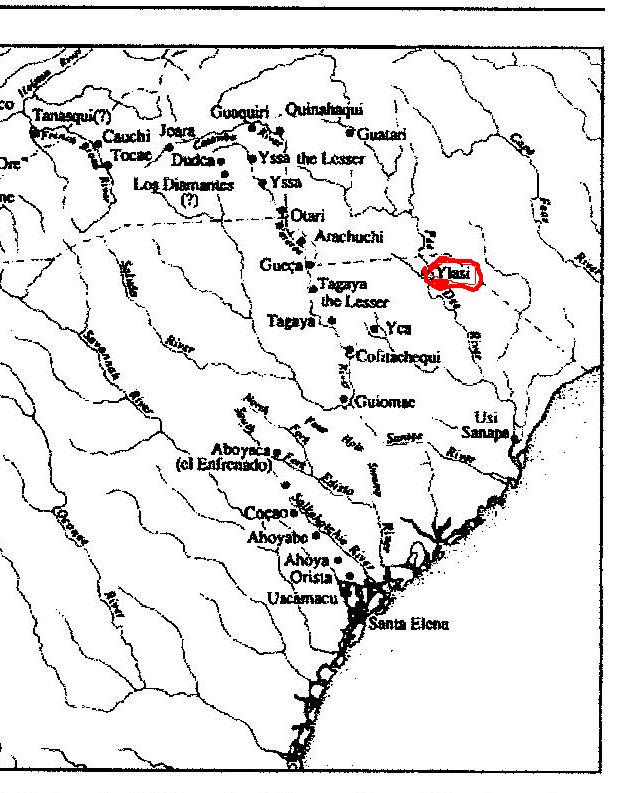
Were these early explorers in Tennessee?  Maybe. We do know that most people who have studied them have deAyllon at the Winyah Bay in South Carolina, and deSoto and Pardo on the Pee Dee River in South Carolina where we find these people known as Melungeons living as early as 1735.


Red indicates town where both deSoto and
Pardo visited. Pee Dee drains into Winyah Bay where
 Lucas deAyllon was found in 1526


In 1848 the ancestry of the Melungeons were published in dozens of newspapers across the country. In 1890 Will Allen Dromgoole went to Newman's Ridge and wrote of the same ancestry.  Indians who had mixed with Portuguese, blacks and whites. Her articles were published not all over the county but also across the seas. How did they become mysterious? They did not forget who they were, they did not make up a story to hide any ancestry and there was nothing mysterious about them and there still isn't.


The caravel ship introduced in the mid-15th century
which aided Portuguese exploration
Photo by Brazilian Navy

Portuguese discoveries is the name given to the intensive maritime exploration by the Portuguese during the 15th and 16th centuries. Portuguese sailors were at the vanguard of European overseas exploration, discovering and mapping the coasts of Africa, Asia and Brazil, in what became known as the Age of Discovery. Methodical expeditions started in 1419 along West Africa's coast under the sponsorship of prince Henry the Navigator, with Bartolomeu Dias reaching the Cape of Good Hope and entering the Indian Ocean in 1488. Ten years later, Vasco da Gama led the first fleet around Africa to India, arriving in Calicutand starting a maritime route from Portugal to India. Soon, after reaching Brazil, explorations proceed to southeast Asia, having reached Japan in 1542.  (Wikipedia)
By the time Jamestown was founded, the Portuguese had been running an Atlantic -- and worldwide -- empire for a century.  Portugal had colonies and outposts on both sides of the Atlantic Ocean and on islands in between and traveled the Atlantic freely.

Beside the Portuguese there are records of Armenians, East Indians, Spanish, Turks, and others in Colonial America. Boatloads of French, Germans, and Swiss. Yet these researchers today sitting in front of their monitors with all of these facts available with a click of the mouse and still they want to make the Melungeons 'mysterious' and make their Portugeuse ancestry a cover story. The Portuguese and their Portuguese Atlantic Creole offspring were sailing all over the Atlantic Ocean and the world but couldn't find their way to America?  Really?

Do these researchers, authors, bloggers have proof these people were something other than Portuguese? No.  They have tested the male DNA of a small sampling of people found in Hancock County which represents ONE ancestor out of thousands and have limited their study to Hancock County families when it is well documented there were pockets of these tawny people living elsewhere.  Furthermore, that DNA was found to be a mix of European and Sub-Saharan haplogroups which could easily have originated with people calling themselves Portuguese.

To put this in perspective we have the Portuguese and Portuguese Atlantic Creoles sailing all over the Atlantic, and we at least three expeditions in the 1500s on the Pee Dee River in South Carolina of Spanish, Portuguese and their slaves who interacted with the Natives in that area.

We have documentation these people who eyewitnesses said were Portuguese Indians were living on the Pee Dee River as early as 1725. These are the same people who went over the mountains in early 1800 to Hancock County and spread out from there.

We have no proof they were anything other than what they said they were.  Some of these researchers will scoff at the above evidence.  They laugh at old court records and testimony of the eyewitness' to history and at the same time cannot produce court records or eyewitness' to history to say they were anything else.

This is not about denying African ancestry. It is there, they themselves said it was there in 1848. One family that shows a male with African DNA does not tell you the history of that family, nor does it mean that all other lines, including the direct female lines could not have been Portuguese/Spanish, Indian or anything else.  Male DNA testing proves nothing but who is related to who and where their one ancestor came from thousands of years ago. 

It would appear the 'one drop rule' is alive and well today.  When Paul Heinegg was told William Chavis was a Saponi Indian his reply was;  he couldn't be an Indian, he was black, thus resorting to a false dichotomy.

Occam's Razor - "The principle states that among competing hypotheses, the one with the fewest assumptions should be selected."  We do not have to assume anything when we look at the 1500 expeditions of Spanish and Portuguese explorers -- they were there.  We do not have to assume they were on the Pee Dee River, there are records.  We do not have to assume the Melungeons 'might have' been on the Pee Dee River, there are records. And we do not have to assume they were Portuguese, they said they were and the records say they were. We do not have to assume these are the same people that came over the mountains and were called Melungeons, there are records. 

The KISS principle states "most systems work best if they are kept simple rather than made complicated". So why do these researchers want to keep complicating things?  Why do they insist this was a cover story when they said they were Portuguese and in the same breath they had mixed with the blacks and whites?  

Why do they want to make the Melungeons all of anything?  These families were mixed from the beginning and mixed as time went on.  Mixed with Africans, other tribes, Swiss, French, Germans, etc. Every family has a different make up.  DNA is never going to prove anything except who is related to who and that these families were mixed. Why the insistence on assuming they were anything but what they freely said there were:  Portuguese Indians who mixed with the black and whites forming the 'present race' in 1848?

There are many interesting articles at the Melungeon Indian Website 

These are some links from the website and the blog referenced in this article.

Early  Contacts

Early Melungeon Researchers

Africans - Portuguese Mixt Crew & Melungeons

Melungeons and The Smithsonian Institute

The Portuguese, DeSoto, The Indians & The Mixed Bloods


Tuesday, January 20, 2015

The Brownlows

Another eyewitness to history was John Bell Brownlow, son of the Parson Brownlow who first wrote in 1840 of the "Melungen" a political opponent from Washington D.C.  (Found Here)


Biographical/Historical Note (Found Here)


John Bell Brownlow was born to William Gannaway "Parson" Brownlow, an ardent East Tennessee Unionist and editor of the Knoxville Whig, and Eliza O'Brien Brownlow in Elizabethton, Tennessee on October 19, 1839. He graduated from Emory and Henry College in Virginia and then served a long internship at his father's newspaper. During the Civil War, Brownlow commanded the Union's 9th Regiment of Tennessee Cavalry. After the war, he served as a special agent for the United States Treasury Department (1865-1866) and then worked for the United States Post Office. In 1904, Brownlow and his son, William G. Brownlow II, started Knoxville's first real estate firm, J. B. & W. G. Brownlow Co. John Bell Brownlow died in 1922.

I don't think anyone could argue that of all the people in Tennessee John B. Brownlow, should have known the history of the Melungeons.  He was personally acquainted with John Netherland who defended the Melungeons in Hancock County (proved they were Portuguese)  and Judge Lewis Shepherd who defended the Hamilton County Melungeons (proved they were Portuguese). 

The Hancock County Trial -John Netherland
The Hamilton County Trial-Judge Lewis Shepherd

And what does this eyewitness to history believe -  were the Melungeons simply "African men and white women"?   John Bell Brownlow writes; "I believe there was some mixture of these Portugese with the Cherokee Indians".....


Watson's Jeffersonian Magazine -
Page 522   1911


THE REMNANT OF AN INDIAN RACE

Dear Sir:

Your letter of yesterday received. I happen to have the information you seek. The Nashville American of  June 26, 1910 (since consolidated with the Nashville Tennessean) published a paper of about 10 pages in celebration of its 98th anniversary and in this paper is the true story of a small number of people to be found in a few counties of East Tennessee, as in other sections of the Appalachian region, called Melungeons or Malungeons. I have traveled horse-back before, during and since the Civil War, in the counties where these people live, and have seen them in their cabin homes and from information received independently of what Judge Shepherd says, I am satisfled his statement is to be relied upon.

The foremost jury lawyer of East Tenn. of his generation was the late Hon. John Netherland, the son-in-law of the John A. McKinney, referred to by Lucy S. V. King, and he gave me the same account, substantially, of the origin of these people that Judge Shepherd does.  Netherland was the Whig candidate for Governor of Tennessee in 1859, against Isham G. Harris. He died in the 80's. He was a slave-owner and practiced law in all the East Tennessee counties, which these people live.
Prior to 1824 free negroes voted in Tennessee, and when in that year the State Constitution was so amended as to disfranchise "all free persons of color", it was sometimes made the pretext of refusing the franchise to these people of perfectly straight hair, small hands and shapely feet who bore no more resemblance to a negro than do members of the Spanish or Portugese embassies of Washington. As to whether they voted or not, in the few counties where they were up to the Civil War, depended upon the disposition of the election officers and the closeness of the contest. But I will add that the election officers were very rarely unfair and their right to vote rarely challenged. Sometimes, in a very close contest, some fellow would challenge it and the man would forego exercising his rights rather than fight about it. They have not been of a lawless or turbulent disposition. They realized the prejudice against them because of their dark complexion. Some of them served in the Confederate, and some in the Federal East Tennessee Regiment, but neither side would have accepted them had they believed they had negro blood in their veins.
In my boyhood days they were called Portugese. The word Mulangeon is comparatively modern as to its general use. As a rule they did not go into either army; did not wish to. They preferred agriculture; happy in their mountain cabins. The extract from McKinney's speech is garbled. He truly said the language of the disfranchising clause included these people because it embraced "all free persons of color" but notwithstanding that the majority of them always voted because their neighbors did not regard them as negroes or as having negro blood in their veins. I believe there was some mixture of these Portugese with the Cherokee Indians, but not with negroes. Lying, sensational newspaper correspondents, from the North, originally started this racket to show that Southern whites were given to miscegenating with negroes, and to have something to write about. Some Southern writers have imitated them, magnifying fifty or one hundred fold the number of these people.
Gen. Wm. T. Sherman did some things I disapproved as much as you do, but he hit the nail on the head when he said that "there were some newspaper correspondents who, to create a sensation and for pay, would slander their grandmothers." Of course, some of the people were shiftless and degraded, as are some of all races, but I remember a notable exception by the name of Wm. Lyle. He was a prosperous country merchant who came to Knoxville every year to buy goods of our wholesale dealers and was treated by every one, with the utmost respect. He was spoken of as a Portugese, and bore no more resemblance to a negro than any Spaniard or Portugese. He dressed elegantly, was well informed and as polished and refined as half the members of Congress, and more so than many of them. In the early history of the country, there were many Spanish and Portugese sailors, who settled on the South Carolina and North Carolina coast. One of these was a Spanish ship carpenter by name of Farragut. In North Calorina, he married a poor girl and drifted to this city (then a town of about 1,200 people) where he followed the trade of house-carpenter, and here was born his subsequently famous son, Admiral David G. Farragut. His Spanish father was a dark-skinned man.

Finally, the decision of the Supreme Court of Tennessee in 1872, referred to by Judge Shepherd, should be conclusive on this subject. Every one of the five members of that Court was a Confederate and Democrat. The Chief Justice, A. Q. P. Nicholson, was the Colleague of Andrew Jshnson in the U. S. Senate in 1861. Jas. W. Deaderick, after this decision and after the death of Nicholson, also of the bench at the time, succeeded Nicholson as Chief Justice. He was not himself in the army but every one of his seven sons were at the front in the Confederate Army, some of whom were badly wounded and the other three Judges had honorable records as Confederate soldiers. Judge Shepherd himself was a Confederate soldier.

JOHN B. BROWNLOW.
P. S. Lyle is not a Portugese name, neither is that of the American Darbey's French, as was that of their ancestor D.Aublgney. 

Wednesday, January 14, 2015

Eyewitness' To History

While waiting for my arm to heal from surgery for frozen shoulder  ( Adhesive Capsulitis) I thought I would copy and paste some of the articles I think are really important to Melungeon History.


Lawrence Clement Johnson was born August 21, 1821 in Chester County, South Carolina.   He died Ausust 14, 1909 at the Confederate home  (Beauvoir) in Gulfport, Mississippi.  He was the son of Dr. Benjamin Brown Johnson and Jane Milling Young Johnson.  He was the grandson of William Johnson, Revolutionary War soldier of Charleston, South Carolina .


After Swan Burnett  read his piece  "Notes on the Melungeons"  (found here)in February of 1889 Mr. Johnson wrote to the editor of the Atlanta Constitution

the following month.


Atlanta Constitution
March 11, 1889
The Melungeons

Meridian, Miss.,
March 11– Editors Constitution

Near a month ago an article appeared in The CONSTITUTION named Melungeons. I laid it aside in order to correspond with the writer, but the paper got destroyed and the name and address had not been noticed with care, and are forgotten. Excuse me then for addressing him through the same medium.

His name Melungeons is a local designation for this small peculiar race. Their own claim to be Portuguese is more generally known. Their original site is on the Pedee river in South and North Carolina . They were once especially strong in Georgetown and Darlington districts of the latter. Though called Portuguese – this does not indicate their true origin. I have no doubt local traditions, and the records still to be found in the Charleston library will give the true account. As dimly recollected, for I never made search with a purpose in view, it was thus in the primary colonial times of the Carolinas, Winyaw Bay was the best and most frequented harbor on the coast, and Georgetown more accessible, was more of a commercial town than old Charlestown., to that port British cruisers sometimes brought prizes. 

Among these once was a Salee Rover, (*See Below) which was sold for the distribution of the proceeds as prize money. The crew consisting mostly of Moors, with a sprinkling of Arabs and negroes, were turned ashore free. Their complexion and religion prevented immediate absorption by the white race, and they found wives among Indians, negroes and cast off white women at a time when many of these last were sold by immigrant ships for their passage money. They became a peculiar people. They were the free people of color of the Pedee region so true to Marion during our revolutionary struggle and no other race in America retained such traditionary hatred of the British.

Your correspondent [whose name I am sorry to have forgotten] having a taste for ethnological studies will confer a favor upon that branch of early post-colonial record and legislative proceedings of South Carolina. He will find it sustained by the appearance of these people if he can find a few pure specimens–their physical structure, their hair, their teeth, and general features, though every trace of their Moslem religion and north African dialect may have long been lost.

Very respectfully,

Laurence C. Johnson 

Sunday, January 4, 2015

The Spanish - Portuguese & the Indians in Colonial Virginia

Anyone who has researched the people called Melungeon, Redbone, Lumbee, etc., has found the argument they could not have been Portuguese/Spanish because they didn't have last names or because there were no Portuguese listed on the early passenger's list.  These records below show a few of the documented Portuguese and Spaniards who was in Colonial Virginia.  The Spanish and Portuguese like the other 'foreigners' and Native Americans had no last names.

The Portuguese and Spaniards, like the Englishmen, who chose to take up with the Natives would not have left any records, just their DNA. 


"And even this Summer Cole and Kitchins plot with three more, bending their courst to Ocanahowan, five daies journey from us, where they report are Spaniards inhabiting."


Ocanahowan?  Occaneechi maybe?  A Spanish Plantation in 1614? Who were these Spaniards living 5 days from Jamestown?  Were they the Spanish/Portuguese explorers left behind by deAyllon, deSoto or Pardo?  Were these the ancestors of the people who would later be called Melungeons, Redbones, Lumbee, etc.?


Lower Norfolk County, Virginia Court Records: Book "A", 1637-1646 & Book B --  By Alice Granbery Walter  (HERE)

Jacob Bradshaw, age 29 years or thereabouts Sworn and examined, sayeth? that he the said deponent, went to Capt. John Sibsey's about November last past, to buy the time out which one Tawney, a Portingall, had then to serve the said Capt. Sibsey and, demanding of Capt. Sibsey how long the said Tawney had to serve him, he told this deponent that the said Tawney had a year and as much as until March next to serve him, whereupon this deponent would not meddle with him but Tawney said that though he came into the country for four years, yet Mr. Page promised him that, in respect he had coasted up and down for him, that he should be servant but for three years, and farther deponent sayeth not. 


Sergeant William Edwards, age 36 years or thereabouts, sworn &  examined, sayeth that there came a man from Linnhaven to the house of Capt. John Sibsey about November last, and demanded of the said Capt. Sibsey whether he would part from a servant of his, being a Portingall, called by the name of Tawney, whereupon the said Capt. Sibsey told him that the said servant had a year
longer to serve him, wherein the said Tawney being then present, said, that he came into the country for four years but Mr. Page, who brought him in, told him that he should serve but three years, and further this deponent sayeth not.


(The beginning of this record is torn)...... good weare..... taken away from MR: THO: WILLOUGHBY by Manuell ye Portuguesse... ordered that ye goods so found be returned unto ye sd Willoubhby & that ye sd Manuell shall not come to or neare the house of ye sd Willoughbys by a mile or have any communicacon with ANN WATKINS his Mayd without ye consent of ye sd WILLOUBHBY & if he shall bee found.... to receive 20 lashes on ye bare back....


PORTUGUESE INDIANS

The Expedition of Batts and Fallam:
A Journey from Virginia to beyond the Appalachian Mountains, September, 1671.
From Annals of Southwest Virginia, 1769-1800. 

September 5th 1671''The three gentlemen bore a commission from Major-general Wood "for the finding out tile ebbing and flowing of the Waters on the other side of the Mountains in order to the discovery of the South Sea." They struck off due west along a trail that was evidently already familiar, and having five horses made rapid progress. On the fourth day 'they reached the Sapony villages, one of which Lederer had visited the year before. They were "very joyfully and kindly received with firing of guns and plenty of provisions." They picked up a Sapony guide to show them to the Totero village by "a nearer way than usual," and were about to leave when overtaken by a reinforcement of seven Appomattox Indians sent them by Wood. They sent back Mr. Thomas Wood's worn out horse by a Portuguese servant of General Wood's whom they had found in the village, and pushed on to the Hanahaskie "town," some twenty-five miles west by north, on an island in the Staunton River. Here Mr. Thomas Wood was left, dangerously ill.'

NORTHAMPTON COUNTY MARY GALE (Living 1673) had an illegitimate child by Portuguese servant Nicholas Silvedo who was convicted on 12/7/1674 as being the father. Silvedo was committed to the custody of Sheriff John Culpeper but later escaped. Meanwhile, the child was kept by William Harman, a Negro, for 13 months and in September of 1673 it was noted that one Jane Harmon was the wet nurse for the child. (Northampton County, Virginia Court Orders and Minutes (1654 - 1795; Orders, Wills, Etc. 1674 - 1679, microfilm No. 27) 

Mary Gale appears again on 9/28/1694. Whereas a male child of Mary Gale, servt. to Mr. John Kendall, of which Nicholas Silvedo was convicted of being the reputed father, was the seventh of December 1674 placed to Charles Guildon of the County until 24 years of age, said child known by the name of Jephtah, now attains to 21 which also appeared by this County's records, set free. [A Mary Gale was brought to Northampton County on 10/3/1678 with seven others by Thomas Kendall, who was granted 400 acres of land.]


FERNANDO APPEALS HIS SUIT TO THE GENERAL COURT
 1667Lower Norfolk County 
Order Book, 1666-1675, fol. 17.

Whereas Fernando a Negro sued Capt. [John] Warner for his freedome pretending hee was a Christian and had been severall yeares in England and therefore ought to serve noe longer than any other servant that came out of England accordinge to the custome of the Country and alsoe Presented severall papers in *Portugell * or some other language which the Court could not understand which he alledged were papers From severall Governors where hee had lived a  freeman and where hee was home. Wherefore the Court could find noe Cause wherefore he should be free but Judge him a slave for his lifetime, From which Judgement thesaid Negro hath appealled to the fifth day of the next Generall Court. [It is not possible to follow this case further owing to the destruc-tion of the General Court records for this period.]


Surry County Tax
#379  George -no last name- living at Lawnes Creek  June 1669  Note; he is a Spaniard
(#947 - living with Edward Warren in 1674 is "welsh" Harry - no last name)


  SHIPWRECKED PORTUGUESE


[Source] Title: Letters to the Secretary of State and others from the Governors, Alexander Spotswood, William Gooch, Robert Dinwiddle and Francis Fauquier, and Presidents Thomas Lee and Lewis Burwell, with enclosures and replies. Depository: Public Record Office / Class: C.O. 5/1344 SR Number: SR 00233 Reel Number: 48 Dates: 1726 - 1783 References: Lists & Indexes, Vol. XXXVI, 29. Andrews Guide 183, List 493. ff. 86-87 Lords of Trade to the Duke of Bedford, 


10 Jan 1750/51. Spanish and Portuguese ships driven into ports of Virginia by bad weather. 
Encloses the four (only adding two) documents listed below: ff. 90-91 Enclosed in the above. Extract of a letter from Thomas Lee to the Board of Trade, 6 Nov. 1750. The Spanish and Portuguese ships driven into Virginia ports have proven irrepairable. The masters have been given permission to hire other ships to carry their cargoes to Europe. 

North Carolina State Archives
General Assembly Session Records
April-May, 1760 Box #2
Committee of Claims

Cornelius Harnett Esqur was allowed his claim of one pound nine shillings eight pence for holding an inquest on the body of one Menasses, a Portugese.


THE LIFE OF DANIEL BOONE by Lyman Draper 
Page 225
A German visiting western Virginia in 1750 was shocked by people of the frontier who culturally were more Indian than white. Such folk seemed to be "a kind of white people...who live like the savages, having a half-Indian appearance" and "nearly allied in disposition and manners to Indians."


Observations gathered out of a Discourse of the Plantation of the Southerne Colonie in Virginia by the English, 1606. Written by the Honorable Gentleman, Master George Percy. 

"At Port Cotage in our Voyage up the River, we saw a Savage Boy about the age of ten yeere, which had a head of haire of a perfect yellow and a reasonable white skinne, which is a miracle amongst all Savages."

Historical Articles - Wayback Machine

  T hese are excerpts from old newspapers and magazines.  Click on the link at the end of the paragraph to read the entire article. Gen. Com...