Thursday, March 10, 2022

John Sizemore M.D.


I have lost the Newspaper source for this article somewhere in my files


John Sizemore, M. D. The community of Prestonsburg has had the services of Doctor Sizemore, a competent physician and surgeon, for the past ten years, and the name has been identified with the medical profession in this part of Eastern Kentucky for upwards of half a century.

Dr. John Sizemore was born in the Big Sandy Valley on Bull Creek two miles above its mouth February 8, 1871, son of Doctor Faries and Mourning (Clark) Sizemore. His great-grandfather was George G. Sizemore, a quarter blood Cherokee Indian who came from the Cherokee Reservation in Eastern Tennessee and spent his last years in Magoffin County. The grandfather of Doctor Sizemore was also named John and was a Union soldier in Company F of the Thirty-nmth Mounted Infantry during the Civil war. His death was the result of an accident in Magoffin County, though his home was on Beaver Creek.

Dr. Faries Sizemore was born on Turkey Creek, a tributary of the Beaver, in 1846. He was a youthful soldier in Company F of the Thirty-ninth Kentucky Mounted Infantry and with this command was in the fighting at Mount Sterling, Cynthiana and Kings Saltworks. He had a cousin, a noted rebel spy, known as Rebel Hawk, and this cousin effected the capture of Faries Sizemore, and the latter remained a prisoner of war for only a few days. Following the war Faries Sizemore studied medicine and all the rest of his life was a deep and devoted student of the science and enjoyed a very high and deserved reputation for his skill in practice. He practiced in Floyd and Carter counties, and finally retired and lived at Paintsville, where he died September 16, 1900. He was a member of the Grand Army Post, also voted as a .republican, and he and his wife are members of the Methodist Episcopal Church. The wife of Dr. Faries Sizemore, Mourning Sizemore, is now eighty-five years of age and lives with her son John. She was born in Kentucky of an old Virginia family. There is one other child, Minnie, wife of M. H. Blivens.

Dr. John Sizemore acquired his early education in the common schools of Floyd and Carter counties, began the study of medicine in his father's office, and subsequently entered the Starling Medical College of Columbus, Ohio, and from there transferred to the Medical College of Ohio at Cincinnati. He was graduated April 9, 1896. Doctor Sizemore has been in active practice for a quarter of a century, beginnmg his professional work at South Portsmouth, Kentucky, later at Ashland, and since 1911 at Prestonsburg. He enjoys a large general practice and is a member of the various medical societies.

In 1889 he married Miss Emma Akers, daughter ot S K. Akers of Van Lear. Their only son Faries Palmer died in childhood. Doctor Sizemore is a Methodist while Mrs. Sizemore belongs to the Missionary Baptist Church. Fraternally he is affiliated with the Knights of Maccabees and the Red Men and is a republican voter.


Sunday, March 6, 2022

Melungeon_Indians Part1 Collins


The Melungeon Indian Families of Tennessee

COLLINS


Will Allen Dromgoole ~ 1890  


There is, perhaps, no more satisfactory method of illustrating this peculiar race, it's origin and blood, than by the familiar tree. Old Vardy Collins, then, must be regarded as the body, or main stem, in this state, at all events.

It is only of very late years the Melungeons have been classed as families. Originally they were tribes, afterward clans and at last families. From Old Vardy the first tribe took it's first name Collins. Others who followed Vardy took the Collins name also.

Old Benjamin Collins, one of the pioneers, was older than Vardy, but came to Tennessee a trifle later. He had quite a large family of children, among them Edmond, Mileyton, Marler, Harry, Andrew, Zeke, Jordon. From Jordan Collins descended Calloway Collins who is still living today and from whom I obtained some valuable information.

But.....go back a step. Benjamin Collins was known as old Ben, and became the head of the Ben's tribe. Old Solomon Collins was the head of Sol's tribe. The race was increasing so rapidly, by emigration and otherwise, that it became necessary to adopt other names than Collins. They fell ,curiously enough, upon the first or Christian name of the head of a large family connection or tribe. Emigrants arriving attached themselves as they chose to the several tribes. After a while, with an eye to brevity, doubtless, the word "tribe" was dropped from ordinary, everyday use. The "Bens" the "Sols" meant the Ben and Sols Tribes. It appeared that no tribe was ever called for Old Vary, although as long as he lived he was recognized as head and leader of the entire people.

This is doubtless due to the fact that in his day the settlement was new, and the people, and the one name Collins covered the entire population. The original Collins people were Indian, there is no doubt about that, and they lived as the Indians lived until sometime after the first white man appeared among them.


  Lewis Jarvis  ~ 1903

“Vardy Collins, Shepherd Gibson, Benjamin Collins, Solomon Collins, Paul Bunch and the Goodmans, chiefs and the rest of them settled here about the year 1804, possibly about the year 1795, but al these men above named, who are called Melungeons, obtained land grants and muniments of title to the land they settled on and they were the friendly Indians who came with the whites as they moved west. They came from the Cumberland County and New River, Va., stopping at various points west of the Blue Ridge. Some of them stopped on Stony Creek, Scott County, and Virginia, where Stoney Creek runs into Clinch River.

The white emigrants with the friendly Indians erected a fort on the bank of the river and called it Fort Blackmore and here yet many of these friendly “Indians” live in the mountains of Stony creek, but they have married among the whites until the race has almost become extinct. A few of the half bloods may be found-none darker- but they still retain the name of Collins and Gibson, &c. From here they came to Newman’s Ridge and Blackwater and many of them are here yet; but the amalgamations of the whites and Indians has about washed the red tawny from their appearance, the white faces predominating, so now you scarcely find one of the original Indians; a few half-bloods and quarter-bloods-balance white or past the third generation.

The old pure blood were finer featured, straight and erect in form, more so than the whites and when mixed with whites made beautiful women and the men very fair looking men. These Indians came to Newman’s Ridge and Blackwater. Some of them went into the War of 1812-1914 whose names are here given; James Collins, John Bolin and Mike Bolin and some others not remembered; those were quite full blooded. These were like the white people; there were good and bad among them, but the great majority were upright, good citizens and accumulated good property and many of them are among our best property owners and as good as Hancock County, Tennessee affords. Their word is their bond and most of them that ever came to Hancock county, Tennessee, then Hawkins County and Claiborne, are well remembered by some of the present generation here and now and they have left records to show these facts.


Robert K. Thomas who surveyed the Native American families in Appalachia.  His report can be found here  although the links have been broken, it is a must read.  

Robert K. Thomas ~ 1980

Dear Mrs.  ----
I am writing to you to thank you and your husband for your kindness to me when I was in Coeburn last month.  I am now finished with my survey of Indian groups in the Southern Appalachians ...  and am back in Michigan.
Since you seemed interested in the history of the Collins family in your area I will pass along to you what I know of their history. 
As far as I can determine; all the Collins' of northeastern Tennessee, southwestern Virginia, and eastern Kentucky are descendants of one household  of Collins who resided in Orange County, North Carolina in 1760; a family of Saponi Indians. I know that it must be mind boggling to imagine that the thousands of Collins' in your area are all descended from just one household, but such is the case.  Further this is not so amazing as it seems.  It is common among pre Revolutionary American families.  .......


Solomon Collins


"Her father was Solomon Collins, a descendant of a friendly Indian who migrated with the whites from Virginia in the early 
settlement of Hawkins, -now Hancock - County

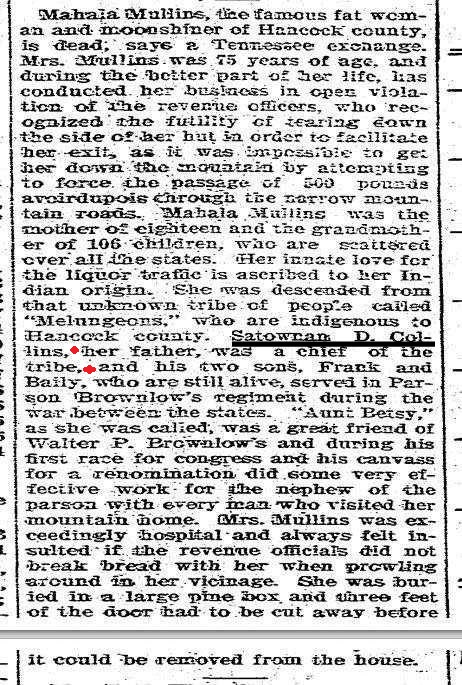
Mahala 

From - Lest We Forget
Jim Callahan


 Satownan D. Collins, her father, 
was a Chief of the tribe


Saturday, March 5, 2022

Chief Tiney Cole


NATIVE INDIANS LIVE IN EASTERN KENTUCKY 

FEW PEOPLE KNOW OF THE PRESENCE OF THE RED MEN

CHIEF TINEY IS THE LEADER 


Live as Other Mountaineers 

                                   Are Honest and Law-Abiding Citizens.


SALYERSVILLE, Ky. Sept 29 1901

It is not generally known that there are Indians scattered all over the mountains of Kentucky, but in nearly every country of the eastern section may be found one or more families named Cole, a Catawba chief, who came here from North Carolina and settled in Floyd County nearly a century ago.

The greatest number of 'Old Billie's' descendants living in one place it the Cole family on Big Lick Branch in Magoffin county. The correspondent recently visited the "Cole Nation" as it is called up there and had a long interview with "Chief Tiney." The correspondent also got a snap shot of the chief and some of his children.

Their surroundings and belongings are very primitive and crude, but they seem as contented with their lot as many people more comfortably situated.  The best house in the settlement is the one shown in the picture, which is the home of "Chief Tiney" and his son's family.  It is a log house of two rooms with porch and floors of poplar planks. 

When see by the correspondent "Uncle Tiney" as everybody calls him was sitting on the porch giving orders to some boys who were repairing a rail fence near the house.  He was bareheaded and his primitive clothes and his long hair made him look like the typical pioneer and Indian. The old man cannot walk without help, but his hearing is good and his eyes are very bright. 

In response to questions Chief Tiney gave the following narrative: 

"I was bred and born in Kentucky, but I don't know just where. Before I came to the Big Lick I lived at different places in Breathitt, Floyd, Johnson and Lawrence counties. My father, 'Old Billie' Cole came from North Carolina. He was three-quarters Indian and was not allowed to vote until after the war but I have voted ever since I was 21 years old.  I have voted for eighteen candidates for president. My first vote was for John Quincy Adams and my last was for McKinley.  I always vote republican. I have lived in the Big Lick a long time and I have outlived nearly all my children.  Me and my old 'ooman' were might poor and could not provide for a large family, so we only raised 14 children to be grown, and now they are all dead but six.  I have 44 grandchildren, 53 great grandchildren and two great-great-grandchildren. 

"I did own a thousand acres of land on this branch but I give it all to my children and I have got nothing now. No I never killed a bear nor deer.  I thought too much of them all, wedge and ax to do much hunting, but I have caught lots of ground hogs and possums and a few coons.  I went hunting with a gun one time but 'daddy' left me to watch by myself and I promised if God would forgive me that time I'd  never to do so again. 

"I don't know much about my people 'Old Billie' my father, brought my mother from Virginia. He had two wives and nine children.  He was 106 years old when he died here on Big Lick.  I will be 96 if I lived til the 24th of next February." 

When asked to sit for a picture "Uncle Tiney" replied:

"Well I never had a picture taken and will if it don't cost too much." 

So the correspondent assisted him to a chair near the house.  He then called for his pipe and "the rifle," and putting his pipe in his mouth where he held it with his hand, as he had not teeth, and the gun across his lap, the old fellow leaned back in his chair with a smile of proud satisfaction and looked the very Chiefest of Chiefs.  He stood by the porch with two swarthy sons and a daughter for a picture of the group. the old chief seemed very proud of the opportunity to talk about his Indian relationship and to have his picture taken but he seemed prouder still of a big twist of ''home-made" which the correspondent gave him. 

Wallace Cole, a son of Chief Tiney is a democratic politician of some local influence.  His brother Shepherd Cole who lives at Hager in this county is a well known lawyer and politician and is a democratic candidate for county attorney.  these two, Wallace and Shepherd Cole, were a little bit more ambitious than their kinsmen. They attended school and for several years Wallace taught the public school in the "Cole district." Wallace being a teacher and Shepherd a lawyer they became the tribe's mentors, so to speak. 

Chief Tiney used to be a famous "witch factor." When the simple folk living near the Cole settlement could not get their bread to rise or their cows to five good milk they would blame the witches and send for 'Old Tiney" who would appear and prescribe remedies, with the result that the superstitious victims would for a time be convinced that the witch had been deprived of her power to inflict further injury.  

The Cole nation schoolhouse is near Uncle Tiney's home.  There are fifty three pupils in the district and thirty seven of them were in school at the time of our visit. The young lady teacher and others having dealings with the folk of that settlement have a great time with the names.  They generally use the same name at several christenings and affix some distinguishing word or phrase. Thus they have Old Valentine and Young Valentine, Big Adam and Little Adam, Preacher John, John Page and John Wesley, Old George, Long George and George Washington.  The settlement has sons named for Washington, Jefferson Buchanan, Lincoln, Tilden and Garfield. 


Links to Cole Family 


Bet Great Granddaughter of  Cherokee Chief Billy Cole

 
1900 Census
Magoffin County, Kentucky

INSTRUCTIONS FOR FILLING THIS SCHEDULE
This modified form of Schedule No 1 is to be used in making the enumeration of Indians, both those on the reservations and those living in family groups outside of reservations.

Detached Indians living either in white or negro families outside of reservations should be enumerated on the general population schedule (Form 7-224) as members of the families in which they are found:  but detached whites or negroes living in Indian families should be enumerated on this schedule as members of the Indian families in which they are found.  In other words, every family composed mainly of Indians should be reported entirely on this schedule and every family composed mainly of person not Indian should be reported entirely on the general population schedule. 

1900-1910 Census - Cole Indians


Although the Coles [and other families] are listed on the 1900 census as Cherokee Indians, living as Indians in Magoffin County, in the Special 1900 Census, a Government Document, their Cherokee Applications in 1907 were rejected.  Oddly in 1910 they are still recognized by the US Government as Indians.
Eastern Cherokee Applications


There is a small group west of that main stream that went north down the Big Sandy River in Magoffin County, near Salyersville, Kentucky.  These people appear to be primarily from this original Granville County group, but one begins to find other families in Magoffin County - Freeman, Perkins, Cole and Nichols, who did not originate in Granville County, North Carolina but are from southeastern Virginia, in Suffolk County; from a small former Indian community called Skeetertown.  
Cherokee Communities in the South - Robert K. Thomas


This article appeared in a number of newspapers and although it mentions a 'picture' of his family and home none of the papers I found carried the pictures.

Although it says 'Old Billie' descended from the Catawba, it could be an error on the part of the journalist or it could be that "Old Billie Cole" was a Catawba and married the woman of the Cherokee Tribe. 


Friday, February 18, 2022

Black Dutch


WHO ARE THE BLACK DUTCH


KNOXVILLE NEWS

SEPTEMBER 10, 1972


Sunday, December 19, 2021

Hanging of George Gibson

THE LAST HANGING IN SCOTT COUNTY VIRGINIA

The long delayed funeral

 PART ONE

The Long delayed funeral

©2002 by Daily News of Kingsport

by Pete Dykes

They buried George Gibson in 1889, but his funeral was held in 1927. 

One of the strange tales out of the Southwest Virginia mountains concerns Gibson, hanged in Gate City following his conviction for a brutal 1888 murder.

His final request, promised solemnly to be fulfilled by authorities present at his execution, was that his funeral be held 38 years in the future.

And so it was.

Just why George Gibson made the unusual request was never explained, and remains a mystery to this day.

But the good people of Scott County, having given their word to the convicted murderer who was about to die, carried it out with a will.

The funeral was held in Bond Town, Wise County, as Gibson had requested, at the Free Will Baptist Church there, with three ministers, Rev. Monroe Hubbard, Rev. Paddie Robinette and Rev. F.J. Kinderly sharing the pulpit for the occasion, each in charge of a portion of the services.

Curious spectators attended from all over East Tennessee, Southwest Virginia, and Eastern Kentucky, for they had never been to a funeral delayed nearly four decades before. Certainly not one that had been specifically requested by the deceased.

Was Gibson hoping that his own funeral would keep his name alive longer than the names of those who hung him?

Did he seek a balm to his tortured soul in the deadness of passing time?

Those questions have never been answered.

On a fine June day, perhaps one very similar to the date on which a rope was looped around Gibson's neck in Gate City to convey him from the land of the living to another state or condition, the tolling bell at the Bond Town Free Will Baptist Church rang out its solemn announcement, and the funeral was held.

Gibson's crime had been a brutal murder, made even more shocking by the discovery that the victim had been his unknown half-brother.

The three ministers out-did themselves.

It was reported that hardly a dry eye could be found in the vast crowd in attendance, by the time the service was concluded.

Perhaps George Gibson had known that 38 years would have to come and go before tears would be shed over his error, his crime, and his lost life.

PART TWO

George Gibson grew to manhood in Scott County, Virginia, and was well-known around Gate City.

In the winter of 1887-88, he, in the company of Wayne Powers, Jonas Powers and Joe Meade, traveled to the headwaters of the Big Sandy River to work at a logging job there.

While working in the lumber camp, the Scott Countians met and became fast friends with a young man named Will Gibson.

Similar or same names were not more uncommon in those days than they are now, and the two Gibsons never attempted to trace any relationship.

Later events established that the men were actually half-brothers, their father having been married a second time, but neither of them suspected such to be the case.

In the spring of 1888, the Powers boys decided to return to Scott County.

George Gibson immediately quit his job as well, saying that he would go back home when they did.

"Why don't you come along, too, Will?" they asked the other Gibson. 

'"You'll like Gate City, and it's some place you ain't never been to, ain't it?"

Will Gibson soon agreed and the men began their journey.

With money in their pockets from the logging work and whiskey easy to come by along the mountain trails, the trip soon turned into a carousing cruise or inebrius expedition, with a fifth, unseen companion, known as The Grim Reaper, tagging closely along.

There were a few scuffles and small fights along the trail, but the real trouble didn't start until the four men arrived at Buffalo Bridge, about one mile distant from Dungannon, Virginia. A large supply of whiskey had been obtained, and the men were drinking heavily. All four were far from sober.

Will Gibson made some jesting remark about "old cross-eyes", referring to Wayne Powers, who was badly affected with twisted optics.

Powers took offense, and a fight ensued, one that was to lead to tragedy and murder.

PART THREE 

George Gibson quelled the fight, but then sided with Wayne Powers.

Perhaps he was a bit jealous of the other man who bore his family name, or maybe it was more natural that the Scott County natives would stick together against a near stranger.

Chances are, however, that the whiskey did most of George Gibson's thinking...and talking ...for him.

"What we ought to do is kill him," George told the Powers boys.

"We ought to just kill him and take his money and clothes, and his share of the liquor. That way, we,d not have no more trouble with him."

Wayne Powers, still smarting from the insulting remark about his crossed eyes, fell into the ready agreements.

"Let's do it," he said.

"Let's kill him!"

Jonas Powers objected.

"Aw," he said "We don't want to do nothing like that. That wouldn't be right at all."

But George Gibson and Wayne Powers were too far gone in intoxication and anger to listen to reason.

Each of them grabbed a club and began to beat Will Gibson about the head with savage, powerful blows.

The victim soon fell dead, his skull crushed and beaten to a bloody pulp before the drunken men fully realized the extent of their violent castigation.

The sobering realization that Will Gibson was dead brought the killers to their senses, but panic and terror at their horrifying deed soon clouded their thinking again.

Will Gibson's body was quickly buried in a shallow, hand-dug trench and covered with fence rails gathered from nearby.

They then set fire to the rails, in hopes that the body would be completely burned up, and hurriedly continued their journey to Gate City.

PART FOUR (CONCLUSION)

Two days later, a farmer was working in a nearby field.

Seeing the pile of partially burned fence rails, he decided to investigate, and therefore discovered the grisly sight of the partially burned body.

The arrest of George Gibson and the Powers brothers followed almost automatically, for they were the only travelers who had passed through the Dungannon section within the past few days.

When word of the horrifying crime spread around Scott County, a lynching party was soon formed, and gathered outside the jail, demanding the immediate hanging of the murderers.

Frightened by the angry mob, George Gibson and Wayne Powers confessed to the sheriff that they had killed Will Gibson. They explained that Jonas Powers had not participated in the killing, but the sheriff felt obliged to hold him for trial as well.

The trial was held in Gate City, before Judge H.S.K. Morrison, then considered one of the most able jurists in the state of Virginia. A jury returned the verdict of guilty for George Gibson and Wayne Powers, exonerating Jonas Powers of any part in the crime and setting him free.

Judge Morrison sentenced the two convicted men to death by hanging, declaring that they deserved no mercy, not even the mercy of death. Scant days later, on a warm June day, George Gibson and Wayne Powers paid for their crimes at the end of ropes in Gate City, to a carnival-like atmosphere of spectators and curious onlookers.

Just before the noose was fastened over Gibson's neck, he asked that no funeral be held for him until 38 years had passed.

A strange request, but one that was granted and fulfilled.


Monday, August 16, 2021

Melungeons at Fort Blackmore


THE MELUNGEONS
 &
FORT BLACKMORE

SOME NOTES


Attorney Lewis Jarvis was born 1829 in Scott County, Virginia and lived in the area and time period where he knew many of the historical Melungeons such as Vardy Collins, the Bolens, and Zachariah Minor. In 1903 he was interviewed for the Hancock County paper and said;  "The white emigrants with the friendly Indians erected a fort on the bank of the river and called it Fort Blackmore and here yet many of these friendly “Indians” live in the mountains of Stony creek." 


The Fort

Daniel Boone and his family lived at Fort Blackmore in present Scott County, Virginia from October of 1773 until March of 1775 and was in command of Fort Blackmore and other forts on the Clinch River in 1774 while the militiamen were engaged in the Point Pleasant campaign of Dunmore's war.  Some of these men did not fight at Point Pleasant but were detached and were with Boone guarding the clinch frontier.  

-------------------------------------------
Were they the 'company of men'  -- the 'friendly Indians' who erected Fort Blackmore as Jarvis said? (See William Herbert's men below)
--------------------------------------------

There were seven of the original forts erected in compliance with Lord Dunmore's order, four on the lower Clinch under Captain William Russell's militia command, and three on the upper Clinch under the militia command of Captain Daniel Smith. These forts were erected by the local militia under the supervision of Colonel William Christian who had been sent out to the frontier by Colonel William Preston who was militia commandant for the area.

When Captain Russell received Lord Dunmore's orders for building the forts it happened to be muster day for the militia in Cassells Woods, and he immediately, on June 25, 1774, laid the facts before his constituents and informed Colonel Preston of their actions on June 26, 1774,  saying: "My company yesterday voted two  forts to be immediately built, I think in as convenient a place as we can get, and we shall immediately begin to build them."

Two weeks later, on July 13, 1774, Captain Russell again wrote to Colonel Preston the following letter showing that his people had changed their minds about the number of forts to be built and states that the forts had already been erected.

"Since I wrote you last, the inhabitants of this river have altered the plan for two forts only, on this river, below Elk Garden, and have erected three; one in Cassells Woods which I call Fort Preston; a second ten miles above which I call Fort Christian; the third, five miles below the first, which I call Fort Byrd, and there are four families at John Blackmores near the mouth of Stony Creek, that will never be able to stand it alone without a company of men. Therefore, request you, if you think it can be done, to order them a supply sufficient to enable them to continue the small fortification they have begun." (5)

Fort Blackmore was built on the north side of the Clinch River opposite the mouth of Rock Branch. The fort was on the extreme frontier of Virginia and was used by hunters, explorers, adventurers, and home seekers for rest and refreshment.


The Men 

From Jeff Weaver's site;  NEW RIVER NOTES

Bios of William Herbert's company     *See more biographies  From Jeff Weaver's site

Micajah Bunch
Listed as living on Indian lands. His land was on Elk Creek in current day Ashe Co., NC. He is in William Herbert's company in 1771.

1774 (Lord Dunmore's War): Micajah was among those diverted to Capt. Looney's company on the Clinch and did not fight at Point Pleasant. Instead he was with Capt Looney, Lieut. Daniel Boone and Lieut. John Cox guarding the Clinch frontier.


John Collins
The Fincastle 1772 and 1773 list includes: David (Indian lands), Ambrose, John, John Jr., Charles (Indian lands), Elisha, Samuel (Indian land), Lewis, George (Indian land) Collins and Micajer Bunch (Indian Land).

1774 (Lord Dunmore's War): One of the John Collins was among those diverted to Capt. Looney's company on the Clinch and did not fight at Point Pleasant. Instead he was with Capt Looney, Lieut. Daniel Boone and Lieut. John Cox guarding the Clinch frontier.


Enoch Osborne 1774 (Lord Dunmore's War): Enoch was among those diverted to Capt. Looney's company on the Clinch and did not fight at Point Pleasant. Instead he was with Capt Looney, Lieut. Daniel Boone and Lieut. John Cox guarding the Clinch frontier. He is listed as a sergeant.

Ephraim Osborne Jr.
1) born 1754 in Rowan Co., NC
2) 1774 (Lord Dunmore's War): Ephraim was among those diverted to Capt. Looney's company on the Clinch and did not fight at Point Pleasant. Instead he was with Capt Looney, Lieut. Daniel Boone and Lieut. John Cox guarding the Clinch frontier...........
Ephraim married Mary Brock (b. before 1774, d. between 1830-1840 in Harlan Co., KY), the daughter of Aaron Brock, sometimes called by his Cherokee name Cutsawah or Red Bird and a Cherokee woman called Sarah. She was a sister to Jesse Brock who fought on the Whig side in the Revolution. It appears that Ephraim or his descendants were present at the Massacre at Yahoo Falls in 1810 on the side of the Cherokee. After this attack, the mixed race Cherokee ceased to exist in Kentucky as Indians and were assimilated into the white population.

Stephen Osborne ---3) 1774: Stephen was among those diverted to Capt. Looney's company on the Clinch and did not fight at Point Pleasant. Instead he was with Capt Looney, Lieut. Daniel Boone and Lieut. John Cox guarding the Clinch frontier

Charles Roark

(Not on Jeff's list, but he is on the list of those paid with Capt. Looney's Co. as were many others in Herbert's company)
Born about 1750, Augusta Co., VA (?). His parents may have been Timothy O'Rourke (b. Ireland, d. Frederick Co., VA?) and Rachel (Timothy married first Sarah Parker, see Timothy Jr. below).

Married Abigail (by tradition a Cherokee Indian) about 1775 in Fincastle Co., VA. She died before 1820 in Ashe Co., NC.
1774 (Lord Dunmore's War): Charles was among those diverted to Capt. Looney's company on the Clinch and did not fight at Point Pleasant. Instead he was with Capt Looney, Lieut. Daniel Boone and Lieut. John Cox guarding the Clinch frontier

William Roberts--- William is probably a brother of Cornelius Roberts and more doubtfully a son of the notorious Capt. James Roberts (Tory leader). He shared an 1780 court venue with Cornelius....He is the William Roberts born about 1744 in old Lunenburg Co., VA who married Elizabeth "Betsy" Walling, daughter of Elisha Wallen and Mary Blevins
   
1774: William was among those diverted to Capt. Looney's company on the Clinch and did not fight at Point Pleasant. Instead he was with Capt Looney, Lieut. Daniel Boone and Lieut. John Cox guarding the Clinch frontier.

Doswell Rodgers----1774: In Herbert's Company. Doswell was among those diverted to Capt. Looney's company on the Clinch and did not fight at Point Pleasant. Instead he was with Capt Looney, Lieut. Daniel Boone and Lieut. John Cox guarding the Clinch frontier.

William Vaughn----1774 (Lord Dunmore's War): William was among those diverted to Capt. Looney's company on the Clinch and did not fight at Point Pleasant. Instead he was with Capt Looney, Lieut. Daniel Boone and Lieut. John Cox guarding the Clinch frontier.....Daniel Boone records meeting him in the wilds of Kentucky on his first visit (Howling Wilderness). William married a Cherokee maiden by the name of Fair-A-Bee-Luna in Tennessee. It was around his wife's tribal fire that he first heard of the old Indian Healing Springs, now known as Eureka Spring, Arkansas. (Don Byrne)........Eddie Davis was unable to prove Fereby's Cherokee ancestry through DNA testing.

James Wallin-- 1746 - born, Lunenburg Co., VA, son of Elisha Walling and Mary Blevins.
1774 (Lord Dunmore's War): James was among those diverted to Capt. Looney's company on the Clinch and did not fight at Point Pleasant. Instead he was with Capt Looney, Lieut. Daniel Boone and Lieut. John Cox guarding the Clinch frontier

Joseph Wallin
1774 (Lord Dunmore's War): Joseph was among those diverted to Capt. Looney's company on the Clinch and did not fight at Point Pleasant. Instead he was with Capt Looney, Lieut. Daniel Boone and Lieut. John Cox guarding the Clinch frontier

Thomas Wallin----1774 (Lord Dunmore's War): Thomas was among those diverted to Capt. Looney's company on the Clinch and did not fight at Point Pleasant. Instead he was with Capt Looney, Lieut. Daniel Boone and Lieut. John Cox guarding the Clinch frontier.

By family tradition, Thomas' daughter Judy was part Cherokee. According to notes in Tobias Harkleroad's Worldconnect database, Thomas was "living with the tribe after his marriage to her mother [Mary Cox?], and taking part in tribal life
Not on the 1782 Montgomery Co., VA personal tax list. - had moved to the Clinch or Powell River valley in Virginia or Tennessee near Kyle's Ford by then


Edward Williams ---
1774 (Lord Dunmore's War): Edward was among those diverted to Capt. Looney's company on the Clinch and did not fight at Point Pleasant. Instead he was with Capt Looney, Lieut. Daniel Boone and Lieut. John Cox guarding the Clinch frontier.

Some of the land in the original Loyal Company grant was also claimed by the Cherokee, who were the first target of these same leaders in the Revolution. Much of the rest of the land was the ancestral home of the Shawnee, who had been driven from northern and central Kentucky by the Iroquois in the 1660s. The men in Herbert's company, including Herbert, were not part of this Loyal Land Company scheme for the most part, although I have heard people suggest that Enoch Osborne and John Cox may have had some long standing business ties to the company. In fact, many of the people in Herbert's company had trading or even familial ties to the Cherokee, and so it is not surprising that so many became Tories when the Cherokee were attacked in 1777.


William Hays came out in 1770, along with Robert Elsom as stock tenders for Capt. William Herbert, Sr. of Poplar Camp, Wythe Co., Va. Herbert had a patent for land between Dungannon and Gray's Island on Clinch River. Robert Elsom was killed there by the Indians in 1777.  Most of the men who served under William Herbert were from Grayson County, Virginia

*See more Biographies  From Jeff Weaver's site


The 1755 Orange County, North Carolina, tax list several families who either they, or their forefather once lived on the Pamunkey River in Louisa County, Virginia and who eventually migrated to Hawkins County, TN and became know as the Melungeons.

Gidean Bunch 1 tithe (mulatto)
Micajer Bunch 1 tithe (mulatto)
Moses Ridley (Riddle) 1 tithe and wife Mary (mulattoes)
Thomas Collins 3 tithes (mulatto)
Samuel Collins 3 tithes (mulattoes)
John Collins 1 tithe (mulatto)
Thomas Gibson 3 tithes (mulatto)
Charles Gibson 1 tithe (mulatto)
George Gibson 1 tithe (mulatto)
Mager Gibson 1 tithe (mulatto)

Most of these families moved from the Flat River to the New River area of Virginia and North Carolina. The following tax lists are from Kegley’s early adventures on the Western Waters) 1771 New River area Botetourt County, Virginia

Charles Collins 1 tithe
John Collins 4 tithes
Samuel Collins two tithes
Charles Sexton 1 tithe
McKegar Bunch 1 tithe
William Sexton 1 tithe

Some of these including Micager Bunch were living on Indian Lands.
Fincastle County was formed from Botetourt in 1772; this 1773 tax list shows the ones living on Indian land. Which means they had crossed the survey line agreed upon in the treaty of Lochaber as the western boundary.

David Collins (Indian Lands)
Charles Collins (Indian Lands)
Samuel Collins (Indian Lands)
George Collins (Indian lands)
*Micajer Bunch (Indian lands)
John Collins SR
John Collins Jr.
Ambrose Collins
Elisha Collins
Lewis Collins


According to an "authentic tradition" related to Robert M. Addington about 1930 by W. S. Cox of Scott County, Virginia,   Baron deTubeuf planned to build a city there just about ten miles above Fort Blackmore on the Clinch River. Tubeuf's colony was very close to where a peaceable band of Indians came down Stony Creek into the neighborhood of Fort Blackmore about  1817 for undetermined ceremonial purposes [prayers were said at a local Indian mound located directly behind the fort].


1


This Web Page Created with PageBreeze Free HTML Editor

Historical Articles - Wayback Machine

  T hese are excerpts from old newspapers and magazines.  Click on the link at the end of the paragraph to read the entire article. Gen. Com...